
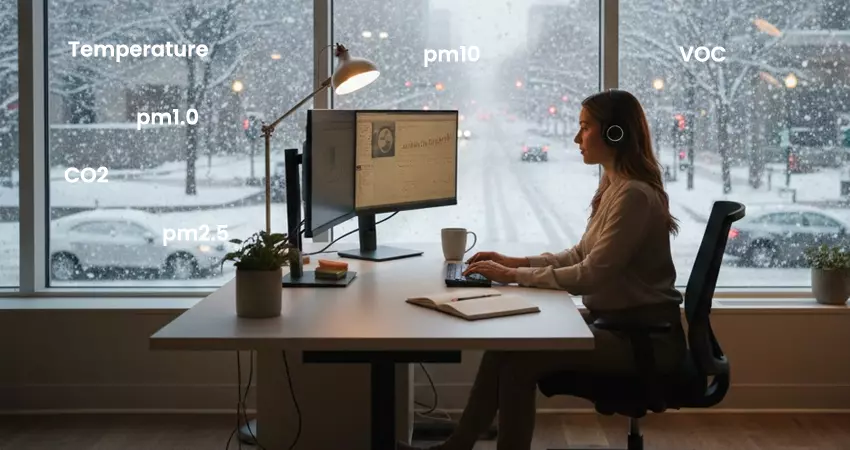


Air Quality Monitoring in Winter: Why Pollution Levels Rise and How to Stay Protected
Winter brings colder temperatures, shorter days, and a shift in how we live indoors. But it also brings something less visible — a significant decline in indoor and outdoor air quality. Studies consistently show that pollution levels often rise during winter months due to a combination of weather patterns, increased heating demand, and reduced ventilation. Understanding these seasonal challenges is essential for maintaining a healthy indoor environment, especially in homes, offices, schools, and public buildings.
With advanced monitoring solutions such as the HibouAir indoor air quality monitoring solution – including Standalone Monitoring Device , and the cloud-enabled HibouAir Cloud Solution – users can better understand how winter affects their indoor environment and take timely action to improve it.
Why Air Quality Worsens in Winter
Temperature Inversions Trap Pollutants
During winter, cold air settles close to the ground while warmer air sits above it – a phenomenon known as temperature inversion. This prevents pollutants such as particulate matter (PM) and smoke from rising and dispersing. As a result, outdoor pollution levels remain trapped near residential areas and commercial zones, allowing harmful contaminants to accumulate.
When outdoor air becomes polluted, it has a direct effect on the quality of the air inside our buildings. This relationship is well understood, as changes in external conditions often influence the indoor environment.
Increased Indoor Heating Leads to Poor Ventilation
In colder months, people tend to keep windows closed for long periods to conserve heat. While this keeps spaces warm, it also reduces natural ventilation – allowing CO2, VOCs, humidity, and airborne particles to accumulate indoors. Poor ventilation is particularly problematic in workplaces and classrooms, where high occupancy increases CO2 levels quickly, impacting comfort, cognitive performance, and overall well-being.
Higher Use of Combustion-Based Heating
Wood stoves, fireplaces, kerosene heaters, and other combustion systems release pollutants such as PM2.5, carbon monoxide, and VOCs. In neighborhoods where wood-burning is common, outdoor PM levels can spike significantly in winter — and easily infiltrate indoors.
Higher Occupancy and Indoor Activities
Winter is a time when families spend more hours indoors and workplaces experience less natural airflow. Everyday activities such as cooking, cleaning chemicals, candles, and electronic equipment all contribute to VOC levels. Without continuous monitoring, these pollutants remain unnoticed.
Why Monitoring Air Quality in Winter Is More Important Than Ever
Winter pollution has been linked to respiratory irritation, asthma attacks, fatigue, headaches, increased virus transmission, and reduced cognitive function. Poor indoor air quality also affects productivity and sleep quality
Because buildings remain closed for most of the season, pollutants accumulate faster indoors than outdoors. This makes real-time monitoring essential for understanding how temperature, humidity, CO2, PM, and VOC levels change throughout the day.
With smart monitoring solutions, it becomes possible to ventilate only when necessary – balancing air quality with energy efficiency. HibouAir’s cloud dashboard, helps users make informed decisions during winter without over-ventilating or compromising comfort.
How Smart Sensors Help You Stay Ahead of Winter Air Quality Challenges
Modern air quality monitors integrate multiple environmental sensors – including CO2, particulate matter, VOC, temperature, humidity, and pressure – into a single, compact device. Solutions such as the HibouAir Duo and the HibouAir Desktop Solution provide real-time, reliable measurements that reveal how pollution levels fluctuate during winter. These devices are adaptable across a wide range of indoor environments, supporting residential homes, apartments, offices, meeting rooms, co-working spaces, educational institutions, healthcare facilities, public buildings, libraries, fitness centers, and hospitality venues. By continuously collecting and presenting detailed environmental data, HibouAir enables users to interpret trends, recognize when ventilation is necessary, and respond to winter-related air quality challenges before they escalate. The platform’s intuitive dashboards, notifications, and historical data analytics reinforce the importance of long-term monitoring.
Small Actions Make a Big Difference in Winter
With the right monitoring tools, improving indoor air quality becomes simple and practical. Actions such as timed ventilation, using extractor fans while cooking, maintaining humidity between recommended ranges, and tracking CO2 levels can drastically enhance comfort and health.
For users looking for a plug-and-play solution to begin monitoring immediately, the HibouAir Standalone Device offers quick setup for homes and small offices. For more advanced use cases, cloud-based solutions support multi-room, multi-building winter monitoring with automated analytics.
Winter is one of the most critical seasons for air quality management. With reduced ventilation, higher pollution emissions, and increased indoor occupancy, indoor environments become more vulnerable to pollution spikes and poor air quality. Real-time air quality monitoring – supported by data-driven insights – ensures healthier, safer, and more comfortable spaces throughout the colder months.