
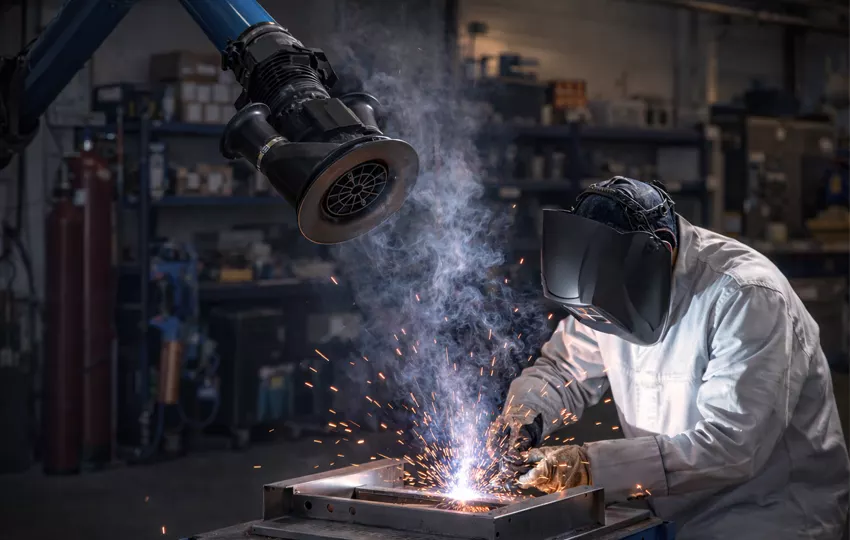


Fume Extraction and Ventilation During Welding: Why Indoor Air Quality Monitoring Matters
Welding plays a vital role in manufacturing, construction, maintenance, and industrial fabrication. From small workshops to large production facilities, welding enables metal structures and components that modern industry depends on. However, welding carried out indoors introduces a significant occupational health challenge that is often underestimated: the accumulation of welding fumes in enclosed spaces.
Unlike outdoor environments where airborne contaminants disperse naturally, indoor welding areas allow fumes and fine particles to remain suspended in the air for extended periods. Without effective fume extraction, ventilation, and continuous monitoring, workers may be exposed to harmful air throughout their shift. This exposure is frequently invisible, gradual, and easy to overlook until health symptoms or compliance issues emerge.
What Are Welding Fumes?
Welding fumes are created when metal is heated to extremely high temperatures and begins to vaporize. As the vapor cools, it condenses into microscopic particles that remain airborne. These particles are often small enough to penetrate deep into the respiratory system when inhaled.
In indoor welding environments, fumes are a complex mixture of fine particulate matter, metal oxides, and gases generated from shielding gases, surface coatings, and residues such as oils or paints. Because many of these particles fall into the PM2.5 and PM1.0 size range, they can stay suspended in the air long after welding has stopped. Over time, repeated welding activity causes these pollutants to accumulate, especially in spaces with limited airflow or ineffective extraction systems.
Health Risks Associated With Welding Fumes
Exposure to welding fumes poses both short-term and long-term health risks. In the short term, workers may experience eye and throat irritation, coughing, headaches, dizziness, and general fatigue. These symptoms are often dismissed as minor or temporary, yet they are early indicators of excessive airborne contamination.
Long-term exposure is more concerning. Prolonged inhalation of fine metal particles and gases has been linked to chronic respiratory conditions, reduced lung capacity, occupational asthma, and increased cardiovascular strain. Certain welding fumes may also affect the nervous system, depending on the materials involved. One of the most serious challenges is that these health effects develop gradually, often without obvious warning signs, making continuous exposure difficult to detect without proper air quality monitoring.
Why Ventilation Alone Is Not Enough
Ventilation and fume extraction systems are essential in welding environments, but they are not foolproof. Many systems operate at fixed airflow rates or are manually controlled, assuming that ventilation performance remains constant under all conditions. In reality, welding intensity, materials, workspace layout, and occupancy levels change throughout the day.
Without measurement, it is impossible to know whether ventilation is adequately capturing and removing contaminants. Filters may become clogged, extraction arms may be positioned incorrectly, or airflow may be insufficient during peak welding activity. In some cases, ventilation continues running unnecessarily when air quality is already acceptable, leading to wasted energy and higher operational costs. Ventilation without monitoring is reactive by nature and provides no confirmation that exposure risks are actually being reduced.
The Role of Indoor Air Quality Monitoring in Welding Areas
Indoor air quality monitoring brings visibility to conditions that would otherwise remain hidden. By continuously measuring airborne particles and environmental parameters, air quality monitors provide objective data about what workers are breathing during welding operations.
In welding environments, monitoring fine particulate matter is particularly important, as these particles are the primary carriers of welding fumes. Additional parameters such as temperature, humidity, and volatile organic compounds also provide valuable context, as they influence how particles behave and how contaminants spread within enclosed spaces. Carbon dioxide levels offer insight into overall ventilation efficiency and air exchange performance. With real-time data, facility managers can identify high-risk periods, poorly ventilated zones, and unexpected pollution spikes as they occur.
Integrating Air Quality Monitoring With Ventilation Systems
The most effective approach to indoor welding safety combines air quality monitoring with automated ventilation control. Instead of relying on preset ventilation schedules, systems can respond dynamically to measured conditions inside the workspace.
When air quality monitors detect rising particulate levels during active welding, ventilation and fume extraction systems can automatically increase airflow. As air quality improves, ventilation can scale back to maintain safe conditions without unnecessary energy consumption. This creates a balanced system that prioritizes worker safety while optimizing operational efficiency. Over time, integrated monitoring also helps identify recurring problem areas, evaluate ventilation design, and support predictive maintenance.
Why Real-Time Data Is Critical in Welding Environments
Welding is not a continuous process. Short periods of intense activity can generate sharp spikes in airborne pollution that may not be reflected in average air quality readings. Real-time monitoring ensures that these peaks are captured as they happen, allowing immediate corrective action.
Continuous data collection also enables long-term analysis. By reviewing historical air quality trends, organizations can identify which welding processes, materials, or shifts consistently generate higher exposure. This insight supports better safety planning, training, and system optimization. Real-time data transforms air quality management from a reactive response into a proactive safety strategy grounded in evidence.
HibouAir and Smart Control of Indoor Welding Air Quality
HibouAir solutions are designed for environments where air quality has a direct impact on health, safety, and operational reliability. In indoor welding facilities, HibouAir monitors provide continuous measurement of key air quality parameters, delivering clear and actionable insights into particulate levels and ventilation effectiveness.
For facilities seeking deeper automation and control, HibouAir ControlHub enables air quality data to be integrated directly with ventilation, extraction, or building management systems. This allows equipment to respond automatically to real conditions on the workshop floor, reducing reliance on manual intervention and fixed rules. By combining accurate sensing with intelligent control, welding environments gain a more resilient and adaptive safety framework.
Welding fumes are an unavoidable part of metal fabrication, but prolonged indoor exposure does not have to be accepted as a risk. Effective fume extraction, proper ventilation design, and continuous air quality monitoring work together to create safer and healthier welding environments.