


How Indoor Air Quality Monitoring Helps Identify Hidden Sources of Pollution
Indoor air pollution is rarely the result of a single obvious problem. In homes, offices, schools, and commercial buildings, air quality issues often develop gradually and invisibly. People may notice headaches, fatigue, poor concentration, or discomfort, but the root cause remains unclear. Without reliable data, indoor air quality problems are frequently addressed through guesswork rather than informed action.
This is where indoor air quality monitoring plays a critical role. By continuously measuring key environmental parameters, air quality monitors make it possible to identify pollution sources, understand when and where problems occur, and take targeted corrective measures instead of relying on assumptions.
The challenge of identifying indoor pollution sources
Indoor environments are complex. Air quality can change from room to room and from hour to hour, influenced by occupancy, activities, ventilation behavior, and even outdoor conditions. Without monitoring, it is difficult to determine whether poor air quality is caused by human presence, building materials, ventilation limitations, or daily activities such as cooking or cleaning.
Many indoor pollution sources are intermittent. A meeting room may experience elevated CO2 levels only during long meetings. Particulate matter may increase briefly during cooking or maintenance work. Volatile organic compounds can rise after cleaning, renovations, or the introduction of new furniture. These events are easy to miss if air quality is only assessed occasionally or based on perception.
Why perception alone is not enough
Human senses are not reliable indicators of air quality. Air can feel fresh while pollutant levels remain elevated, and unpleasant symptoms may appear long after the original pollution event has passed. Relying on smell, temperature, or comfort alone often leads to delayed or ineffective responses.
This uncertainty can result in over-ventilation, under-ventilation, or unnecessary investments in equipment that do not address the real issue. Without data, it is difficult to justify changes to ventilation strategies or building operations, especially in professional or regulated environments.
How air quality monitoring reveals pollution patterns
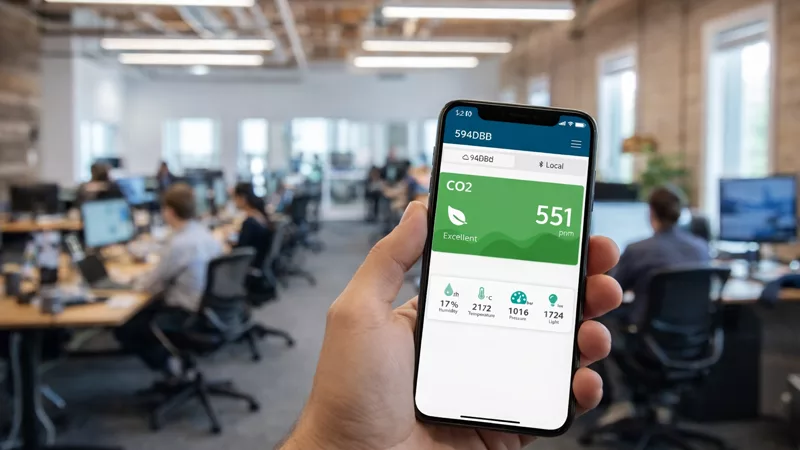
Continuous indoor air quality monitoring replaces assumptions with measurable evidence. By tracking parameters such as CO2, particulate matter, temperature, humidity, pressure, and VOC levels over time, monitoring systems reveal patterns that are otherwise invisible.
When air quality data is viewed alongside time and location, it becomes possible to see clear correlations. CO2 levels that rise consistently during occupied hours point to ventilation limitations. Particulate spikes that coincide with specific activities indicate localized sources. VOC trends that appear after cleaning or refurbishment suggest chemical emissions rather than outdoor pollution.
These insights help building owners, facility managers, and homeowners understand not only that a problem exists, but also why it exists.
From raw data to actionable insight
The real value of indoor air quality monitoring lies in interpretation. Historical data and real-time trends allow users to compare different rooms, identify recurring events, and distinguish between temporary fluctuations and long-term issues.
For example, monitoring can show whether poor air quality is driven by occupancy density, insufficient airflow, or external pollution entering the building. It can also confirm whether corrective actions, such as adjusting ventilation schedules or changing cleaning products, have a measurable impact on indoor conditions.
Modern monitoring solutions provide clear visualizations through dashboards, making it easier to communicate findings to decision-makers and support data-driven improvements.
Supporting healthier indoor environments
By identifying pollution sources accurately, indoor air quality monitoring supports healthier and more comfortable environments. In offices, this can lead to improved concentration and productivity. In schools and care facilities, it contributes to better well-being and reduced health risks. In residential spaces, it empowers occupants to make informed lifestyle and ventilation choices.
Monitoring also supports long-term building performance by preventing issues related to moisture, poor ventilation, and air stagnation, which can otherwise lead to costly maintenance or compliance challenges.
The role of modern monitoring solutions
Advanced indoor air quality monitoring solutions, such as those offered by HibouAir, combine multiple environmental sensors into a single device to provide a comprehensive view of indoor conditions. Rather than focusing on a single parameter, multi-sensor monitoring makes it easier to identify relationships between different pollutants and environmental factors.
By continuously collecting and presenting accurate air quality data, these systems help users move from reactive responses to proactive management of indoor environments.
Turning awareness into action
Identifying the source of indoor air pollution is the first step toward meaningful improvement. Indoor air quality monitoring transforms invisible risks into visible, measurable information, enabling targeted actions that address the real cause of the problem rather than its symptoms.
As awareness of indoor environmental quality continues to grow, data-driven monitoring is becoming an essential tool for anyone seeking healthier, more efficient, and more resilient indoor spaces.