
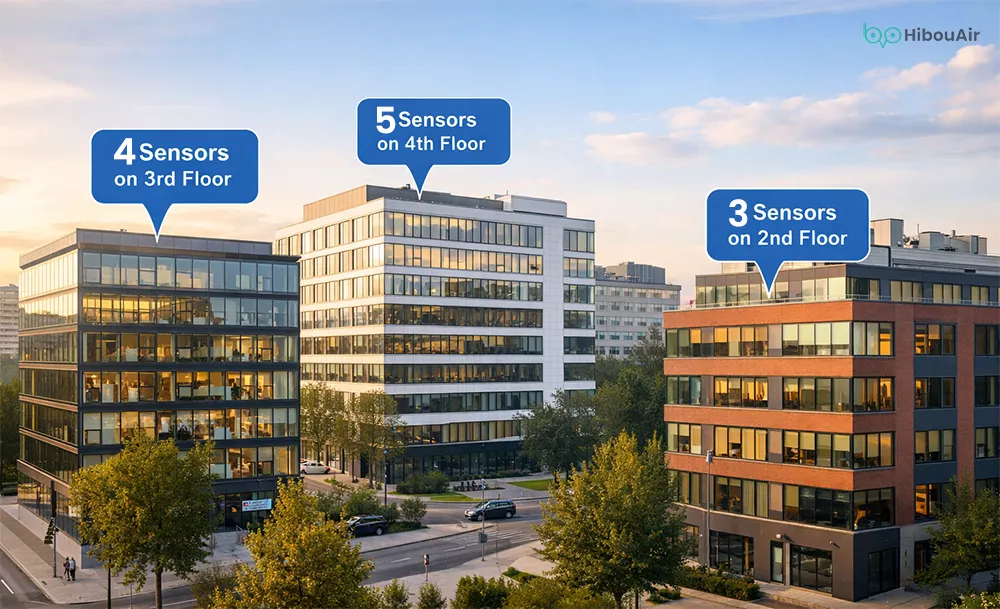


How Many Air Quality Sensors Do You Need Per Building? A Practical Sizing Guide
When organizations begin planning indoor air quality monitoring, one of the most common questions is: How many sensors do we actually need per building?
It sounds like a simple question, but the answer depends on several practical factors — building layout, room function, ventilation zoning, occupancy patterns, and the type of monitoring solution you choose.
Installing too few sensors creates blind spots. Installing too many may increase cost without improving insight. The goal is not to cover every square meter with a device, but to measure the areas where air quality truly changes.
This guide provides a structured way to estimate sensor count in commercial buildings such as offices, schools, healthcare facilities, retail spaces, and mixed-use properties.
Step 1: Understand the Building Layout
Before deciding how many sensors you need, start by looking at your building in a simple way. How many floors does it have? How many rooms are on each floor? Are the spaces open or divided into smaller offices? Is the ventilation system shared across the floor or split into different zones?
Air quality is not the same everywhere inside a building. A sensor near the entrance will not show the same readings as a meeting room on the top floor. Even on the same floor, different rooms can have very different air conditions depending on how many people are inside and how the air flows.
So the first step is not technical. Just draw a basic map of the building and understand how the spaces are used. This makes the next steps much easier.
Step 2: Room Type Is More Important Than Size
Many people think they should calculate sensors based on square meters. But in reality, the type of room matters more than the size.
For example, a large open office with steady occupancy might only need one or two sensors, depending on how the ventilation is designed. But a small meeting room can fill up quickly, and CO₂ levels can rise fast during a one-hour meeting. That small room may need its own sensor even though it is not big.
Kitchens and break rooms are also special cases. Cooking, coffee machines, and cleaning products can increase particles and VOC levels. These changes may not affect the whole building, so placing a sensor directly in the kitchen gives clearer information.
Healthcare rooms, waiting areas, and retail entrances also behave differently from normal offices. Some spaces are quiet and stable, while others change constantly during the day. That is why you should decide sensor placement based on how each space is used, not just how big it is.
Step 3: Estimate Sensors Per Floor
Once you understand the rooms, it becomes easier to calculate how many sensors you might need per floor.
Let’s imagine a simple example. Suppose one floor has a large open office area, two meeting rooms, and one kitchen. The open office might need one or two sensors depending on the ventilation layout. Each meeting room would ideally have one sensor. The kitchen would also benefit from one.
In this example, you might end up with around five sensors on one floor. If the building has four similar floors, that could mean about twenty sensors in total.
This is not a fixed rule, but it gives you a realistic way to think about it. Instead of guessing a total number for the whole building, calculate floor by floor and room by room.
Step 4: Check Your Ventilation Zones
The ventilation system plays a big role in deciding sensor count.
If your building has different HVAC zones, each zone should ideally have at least one sensor. This is especially important if you plan to automate ventilation based on CO₂ levels.
For example, if one side of the floor has its own air supply and the other side has a separate system, using just one sensor for the whole floor may not give accurate control. One area could be over-ventilated while another area is under-ventilated.
When sensors match the ventilation zones, the system works better. The data becomes more meaningful, and ventilation can respond correctly to real conditions.
Desktop Solution vs Cloud Deployment: How It Affects Planning
The number of sensors is influenced not only by building layout but also by connectivity strategy.
In a local deployment like HibouAir Desktop Solution, sensors broadcast data via Bluetooth Low Energy. A desktop application or gateway collects this information locally, stores historical data, and provides real-time dashboards without requiring cloud connectivity. This approach has several advantages: it avoids ongoing cloud dependency, supports offline operation, and allows direct access to historical data and export functions.
However, BLE coverage must be considered. Indoor Bluetooth range typically varies between 10 and 30 meters depending on walls, materials, and interference. Large buildings may require multiple gateways to ensure reliable data collection. When planning sensor quantity in a desktop-based environment, both monitoring needs and signal coverage must be evaluated together.
In contrast, WiFi-enabled cloud deployments like HibouAir Cloud Solution remove range limitations associated with Bluetooth. Each device connects directly to the network and sends data to a centralized dashboard. As long as WiFi coverage exists, physical distance from a gateway is not a constraint. This makes scaling across multiple floors or buildings simpler. Additionally, cloud solutions allow remote access from anywhere in the world, centralized analytics, and multi-building management.
In cloud-based setups, sensor count is determined purely by monitoring requirements rather than connectivity constraints.
Rough Sizing Guide by Building Type
| Building Type | Approximate Sensor Density |
|---|---|
| Small office (under 300 m²) | 2–3 sensors |
| Medium office (per floor) | 4–6 sensors |
| Large commercial floor | 1 per HVAC zone |
| School | 1 per classroom |
| Healthcare | 1 per patient cluster |
| Warehouse | 1 per large zone |
| Restaurant | 1 dining + 1 kitchen |
This table serves as a practical starting point. Actual requirements may vary depending on ventilation design and occupancy behavior.
When Fewer Sensors May Work
In small, open-plan buildings with uniform ventilation and consistent occupancy, fewer sensors may still provide meaningful insight. If airflow is well-mixed and there are no isolated high-occupancy areas, a limited number of strategically placed units may be sufficient.
However, reducing sensor count increases the likelihood of blind spots. In dynamic commercial environments, variability is more common than uniformity.
When You Need More Sensors
Additional sensors become necessary when occupancy varies significantly throughout the day, when ventilation zones differ, or when compliance reporting is required. Buildings pursuing ESG documentation or energy optimization strategies often benefit from more granular monitoring. Automation systems also rely on accurate, zone-specific data to perform effectively.
More detailed monitoring improves ventilation control, energy efficiency, and occupant comfort while supporting regulatory transparency.
The Cost vs Insight Balance
The decision should not be driven solely by device count but by insight value. Installing additional sensors may increase upfront cost, but poor ventilation can lead to higher energy consumption, reduced productivity, and health-related impacts.
Accurate data allows building managers to fine-tune ventilation systems instead of relying on fixed schedules or assumptions. In many cases, better data leads to operational savings that outweigh the initial investment.
Final Practical Recommendation
There is no universal number of sensors per building. Instead of asking how many devices are required, it is more useful to ask how many ventilation zones exist, where occupancy peaks occur, and where pollutant sources originate.
Start by monitoring air quality in high-priority areas such as conference rooms, open office zones, kitchens, and high-traffic spaces. Align sensors with ventilation branches whenever possible. Then scale based on real-world data and insights.
By approaching sensor placement strategically rather than uniformly, commercial buildings can achieve accurate air quality visibility, enable smarter ventilation control, reduce energy waste, and create healthier indoor environments.