


How to Place Indoor Air Quality Monitors in Offices and Commercial Buildings
Installing an indoor air quality monitor is a powerful step toward improving workplace health and performance. But for facility managers, simply installing a device is not enough. Where that monitor is placed will determine whether the data supports smart building decisions — or quietly leads you in the wrong direction.
In commercial environments, air does not behave evenly. Temperature, humidity, ventilation flow, and occupant density all create microclimates within a single space. A monitor placed in the wrong location can measure the air from an HVAC vent, a sunlit window, or a rarely used corner — none of which represent what employees are actually breathing throughout the day.
For air quality monitoring to be useful in an office or commercial building, placement must be intentional and strategic.
Start With the Breathing Zone
The most important concept in commercial IAQ monitor placement is the breathing zone. This refers to the vertical range where occupants inhale air during normal activity. According to commonly referenced guidelines such as ASHRAE and WELL, this zone sits approximately 1.1 to 1.7 meters (3.6 to 5.6 feet) above the floor.
This range represents seated and standing head height in typical office environments. Placing a monitor too close to the ceiling often results in warmer air readings and diluted CO2 values. Installing it near the floor can exaggerate particulate accumulation or temperature differences that occupants are not directly exposed to.
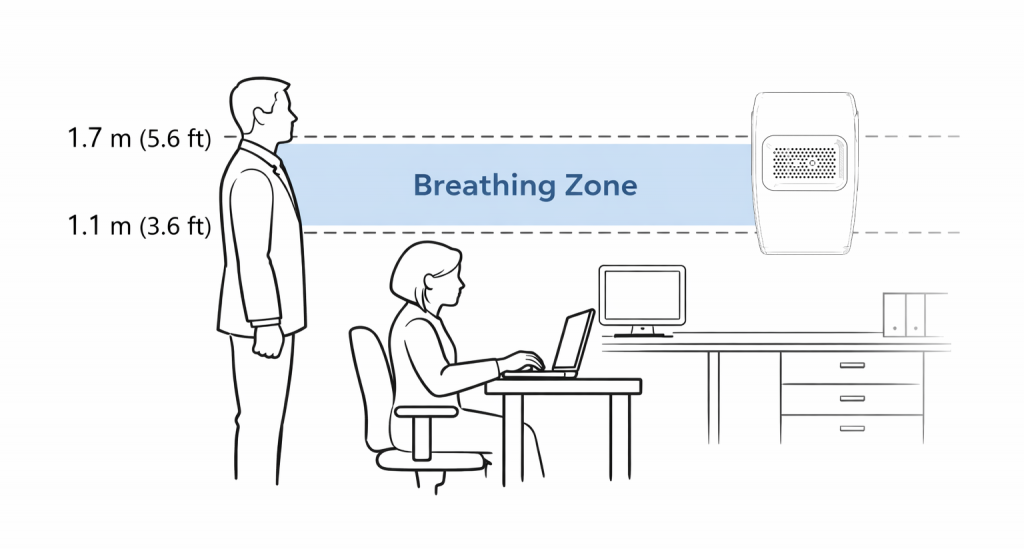
In a conference room, for example, mounting a device at seated head level ensures that rising CO2 concentrations during meetings are accurately captured. In open workspaces, a centrally positioned wall mount at eye level usually provides the most representative measurement of real occupant exposure.
When monitors are positioned within the breathing zone, the data reflects lived conditions — not architectural extremes.
Avoid Direct Influence From HVAC and Openings
Modern commercial buildings rely heavily on mechanical ventilation systems. Supply diffusers introduce conditioned air that may differ significantly from the ambient room average. A monitor installed directly beneath an air supply vent might report excellent air quality, while employees a few meters away experience rising CO2 and stale air.
Similarly, windows and exterior doors introduce rapidly changing temperature and humidity conditions. Direct sunlight can heat sensor surfaces, artificially elevating temperature readings and altering relative humidity calculations.
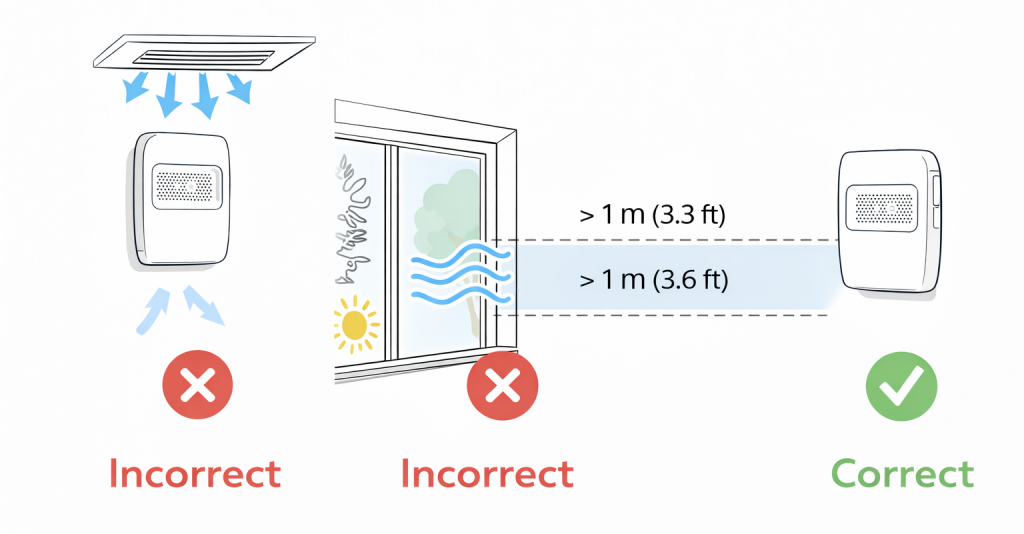
To maintain reliable indoor air quality data, monitors should generally be positioned at least one meter away from HVAC supply vents, air returns, operable windows, and exterior doors. The goal is to capture stable, mixed room air rather than freshly delivered or outdoor-influenced air.
This simple adjustment can significantly improve data accuracy.
Understand How Humidity Affects Measurements
Humidity is often overlooked, yet it plays a major role in sensor behavior. In many commercial-grade air quality monitors, particulate matter is measured using optical particle counting. When relative humidity becomes elevated, airborne particles can absorb moisture and grow in size. This process can cause the monitor to overestimate particulate mass concentration.
Similarly, some VOC sensors are sensitive to moisture levels. High humidity can alter the chemical reactions occurring at the sensor surface, influencing baseline readings.
If a device is placed near a humidifier, kitchen area, or poorly ventilated corner, it may display pollutant levels that reflect localized moisture conditions rather than overall building performance.
This is why thoughtful placement is not only a spatial decision — it is a scientific one. By positioning monitors in areas with stable ambient conditions, facility managers reduce the risk of distorted readings and unnecessary corrective actions.
Place Monitors Where People Actually Work
The most valuable air quality data comes from spaces that are regularly occupied. Reception areas, open workstations, conference rooms, private offices, and collaborative zones are typically the most critical monitoring points in commercial environments.
Installing monitors only in storage rooms or low-traffic corridors may provide data, but it does not represent the exposure conditions of building occupants.
Carbon dioxide, in particular, is closely tied to occupancy. In meeting rooms, levels can rise quickly during extended sessions. Without proper monitoring in those spaces, ventilation issues may go unnoticed until complaints arise.
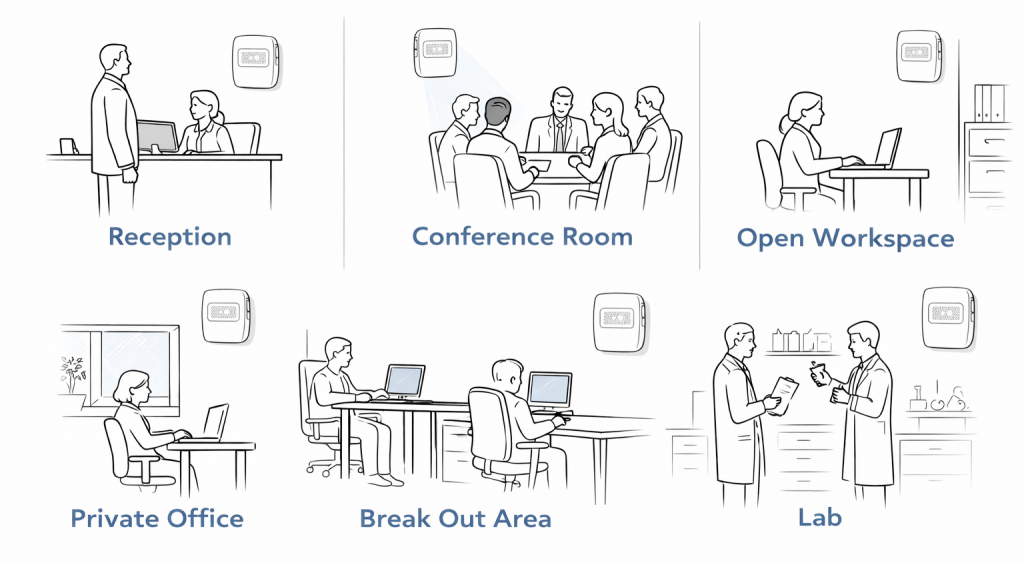
A well-designed commercial air quality monitoring strategy reflects population density and usage patterns. The monitor should be where people spend time — not hidden in mechanical spaces.
Consider Building Layout and Monitor Density
Larger commercial buildings introduce additional complexity. Different HVAC zones, floor orientations, and occupancy densities can produce varying air quality conditions within the same property.
Industry guidance and building standards often suggest coverage guidelines of roughly 325 square meters (3,500 square feet) per monitor, though practical deployment depends heavily on layout and ventilation design. Separate conference rooms typically require independent monitoring. Distinct HVAC zones should not rely on a single sensor for representation.
Higher monitor density improves resolution and diagnostic capability. Even in cost-sensitive deployments, placing monitors strategically in both high-occupancy and lower-occupancy areas provides a more complete picture of building performance.
For facility managers, the objective is not simply coverage — it is actionable insight.
Avoid Common Placement Mistakes
Many monitoring issues stem from predictable errors. Mounting a device directly under a vent, near a printer, beside a cleaning supply cabinet, or in a stagnant corner can produce skewed readings. Positioning the unit too high, too low, or behind furniture limits airflow around the sensors.
Even small placement adjustments can dramatically improve reliability.
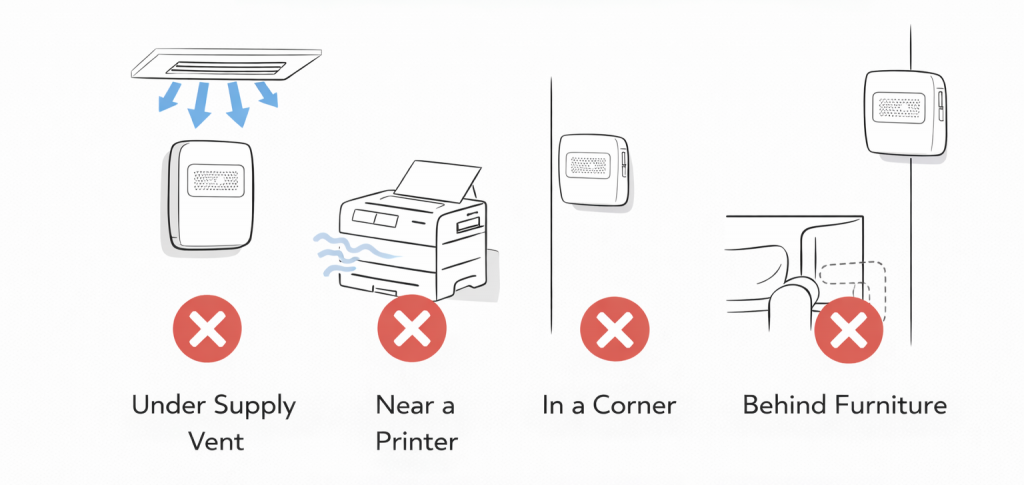
The aim is always the same: measure the air that occupants experience, not the air influenced by isolated events or architectural anomalies.
Turning Data Into Building Intelligence
Air quality monitoring should not be a passive compliance exercise. When placed correctly, monitors provide insight into ventilation efficiency, occupancy-driven CO2 trends, humidity control performance, and pollutant patterns over time.
Facility managers can use this information to optimize HVAC schedules, validate ventilation upgrades, support sustainability reporting, and proactively address comfort complaints.
Systems such as HibouAir are designed to support this approach by combining real-time measurements with historical trend analysis and alert thresholds. When deployed strategically within the breathing zone and away from direct environmental influences, such systems provide reliable data that supports informed building management decisions.
Correct placement transforms raw data into meaningful intelligence. And meaningful intelligence is what drives healthier, more productive commercial environments.