
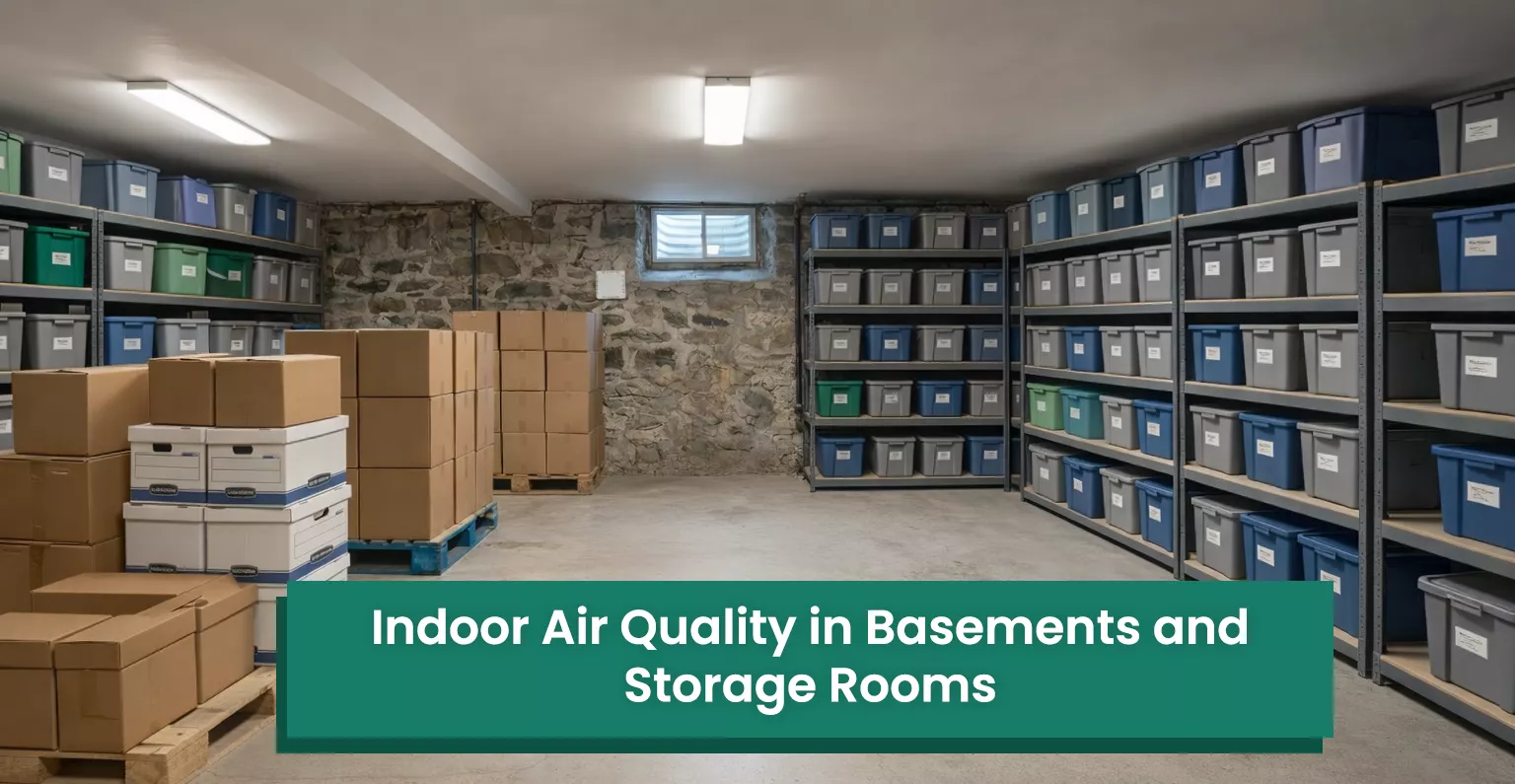


Indoor Air Quality in Basements and Storage Rooms: The Overlooked Risk Zone
When indoor air quality is discussed, the focus almost always falls on visibly occupied areas—offices, production zones, or meeting rooms. Basements and storage rooms are rarely part of the conversation. They are seen as secondary spaces, places people pass through briefly rather than environments that demand active management.
This assumption is precisely what makes indoor air quality in basements and storage rooms such a persistent and underestimated risk. These areas operate quietly in the background of a building, often accumulating air quality problems long before anyone notices there is an issue at all.
The Conditions That Make Basements a Problem
Basements and storage rooms share structural characteristics that naturally work against healthy air. Limited ventilation, low air movement, and reduced daylight create environments where air tends to stagnate. Moisture intrusion from surrounding soil or plumbing further complicates the picture, raising humidity levels that rarely receive attention until damage appears.
Storage itself adds another layer of complexity. Packaging materials, cleaning products, maintenance supplies, and archived goods all emit pollutants over time. In enclosed spaces, CO2, volatile organic compounds, and fine particulate matter do not disperse easily. Instead, they linger and accumulate, creating conditions that are unhealthy for both people and materials.
The Silent Damage to Stored Assets
Beyond health considerations, poor air quality in basements and storage rooms directly affects what is stored there. Elevated humidity accelerates mold growth and corrosion. Paper records degrade, electronic components fail prematurely, and stored inventory loses quality long before visible signs appear.
For facilities that rely on long-term storage—archives, healthcare supplies, spare parts, or sensitive equipment—these conditions create hidden costs. The absence of monitoring means problems are often discovered only after materials are already compromised.
Why Air Quality Monitoring Changes the Equation
The core issue is not that basements are inherently problematic, but that they are unmeasured. Without continuous insight, facility teams are left guessing. Occasional inspections or odor complaints provide no meaningful understanding of how conditions behave over time.
This is where air quality monitoring becomes essential rather than optional. Continuous measurement of CO2, humidity, temperature, VOC levels, and particulate matter reveals slow-developing patterns that would otherwise remain invisible. Instead of reacting to symptoms, teams gain the ability to recognize early warning signs and intervene before damage or complaints occur.
How HibouAir Fits Naturally Into These Spaces
Solutions like HibouAir are particularly effective in basements and storage rooms because they are designed to operate quietly and consistently, without requiring constant user interaction. These are not spaces where people check dashboards daily, and they shouldn’t need to.
By continuously tracking indoor air conditions, HibouAir provides a factual record of what is actually happening below ground. It highlights recurring humidity issues, identifies pollutant spikes tied to specific activities, and removes uncertainty from decision-making. In spaces that have traditionally been ignored, that visibility alone represents a major shift.
From Awareness to Control
Monitoring, however, is only the first step. Knowing that air quality is poor does little good if action depends on someone noticing a problem and responding manually. In overlooked spaces, that delay can be costly.
This is where HibouAir ControlHub plays a decisive role. By allowing air quality data to automatically drive ventilation or air exchange, ControlHub turns passive monitoring into active protection. When conditions drift outside acceptable ranges, corrective action happens without waiting for human intervention.
The result is not aggressive ventilation or constant airflow, but balanced control. Air quality improves when needed and stabilizes once conditions return to normal, protecting both the space and the energy profile of the building.
Basements and storage rooms are rarely included in discussions about indoor air quality strategy, yet they often define it. These spaces influence moisture levels, pollutant movement, and long-term building health more than their low visibility suggests.
Treating them with the same seriousness as occupied areas is not about overengineering. It is about acknowledging that indoor air quality is a system, not a collection of isolated rooms. When basements and storage areas are monitored and managed properly, the benefits extend upward—improving overall air quality, protecting assets, and preventing problems before they surface.