
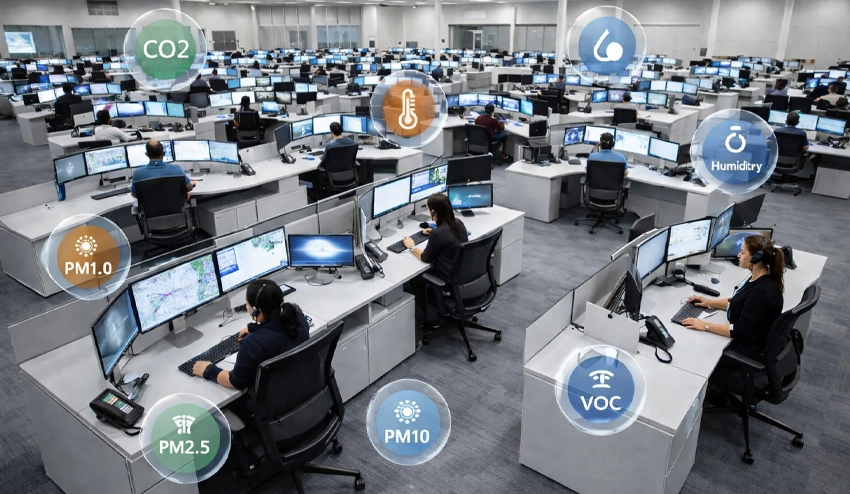


Indoor Air Quality in Call Centers: CO2, Noise, and Productivity in Dense Work Areas
Call centers are designed for people, not machines. Hundreds of employees may work in the same space, often seated close together, speaking continuously, and spending long hours indoors. While most call centers pay attention to seating, lighting, and temperature, one critical factor is often overlooked: indoor air quality.
Poor air quality does not usually cause immediate failure, but it directly affects concentration, energy levels, communication quality, and overall productivity. In dense work environments like call centers, air quality issues can quietly reduce performance, increase fatigue, and contribute to higher absenteeism and staff turnover.
Monitoring indoor air quality helps make these invisible problems visible and gives facility teams the data they need to improve working conditions in a measurable way.
Why call centers are especially vulnerable to poor air quality
Unlike offices where people move around frequently, call centers have several characteristics that increase air quality risk. Occupancy density is high, people speak constantly, and many employees remain at their desks for extended periods. This leads to faster buildup of CO2 and higher noise levels, even when the room temperature feels comfortable.
Ventilation systems may not always adapt well to rapid changes in occupancy, such as peak shifts, overtime hours, or seasonal staffing increases. As a result, air quality can degrade during the day without anyone noticing until performance begins to drop.
Because these changes happen gradually, they are often mistaken for “normal tiredness” rather than environmental stress.
CO2 and cognitive performance in call centers
CO2 is one of the most important indicators of indoor air quality in call centers. CO2 itself is not toxic at typical indoor levels, but rising CO2 strongly indicates inadequate ventilation.
As CO2 levels increase, people commonly experience reduced concentration, slower reaction time, headaches, and mental fatigue. In a call center, this can lead to longer call handling times, more errors, reduced customer satisfaction, and increased stress for employees.
When CO2 is monitored continuously, it becomes clear how closely air quality follows occupancy and ventilation patterns. Teams can then adjust ventilation schedules or airflow based on real usage rather than fixed assumptions.
Noise: an overlooked environmental stress factor
Noise is a daily reality in call centers. Constant conversations, ringing phones, HVAC systems, and background equipment all contribute to sound levels that may not feel extreme but are persistent.
Over time, elevated noise increases stress, reduces speech clarity, and contributes to mental exhaustion. Employees may unconsciously raise their voices to compensate, further increasing noise levels across the room.
Monitoring noise does not replace acoustic treatment, but it provides valuable insight. Changes in noise patterns can indicate overcrowding, layout issues, or ventilation systems working harder than expected. Over time, noise trends can support better space planning and operational decisions.
Temperature and humidity still matter
Temperature comfort remains important in call centers, but comfort alone does not guarantee a healthy environment. A space can feel cool while still having high CO2 or poor ventilation.
Humidity also plays a role. Air that is too dry can cause throat irritation and vocal strain, especially in environments where employees speak continuously. High humidity, on the other hand, can increase discomfort and contribute to poor perceived air quality.
The key is to monitor temperature and humidity together with CO2 and noise, rather than treating them as separate issues.
Air quality problems are hard to spot without data
Most call center air quality issues do not trigger alarms. There is no obvious “failure moment.” Instead, performance declines slowly.
Supervisors may notice higher fatigue later in the day, more sick leave during certain seasons, or lower productivity during peak hours. Without environmental data, these patterns are often attributed to workload or staffing rather than indoor conditions.
Continuous air quality monitoring creates a clear picture. It shows when CO2 rises, how noise changes during shifts, and how temperature and humidity behave across the day. This makes it easier to separate environmental problems from operational ones.
Using trends to improve productivity and well-being
One of the biggest advantages of air quality monitoring is trend analysis. Instead of reacting to complaints, teams can proactively identify patterns.
For example, CO2 levels may rise sharply after lunch when the room refills, or during evening shifts when ventilation settings are reduced. Noise may peak during certain campaigns or seasonal hiring periods. These insights allow managers to adjust ventilation, staffing layout, or break schedules to reduce stress and maintain performance.
Over time, these small adjustments can improve productivity, reduce burnout, and support employee retention.
Integrating air quality monitoring with HVAC and BMS
Air quality monitoring becomes even more effective when it is connected to HVAC or building management systems.
If CO2 levels rise above a defined threshold, ventilation can automatically increase. If noise levels indicate overcrowding or system strain, alerts can prompt operational changes. If temperature or humidity drifts outside the comfort range, corrective action can be taken before complaints begin.
This type of integration turns air quality data into action, ensuring the indoor environment responds to real conditions rather than static schedules.
How HibouAir supports call center environments
HibouAir is designed for continuous indoor air quality monitoring in real working environments, including dense office spaces and call centers.
Devices such as the HibouAir Duo air quality monitor measure CO2, temperature, humidity, noise, particulate matter, and other relevant parameters in a single compact unit. This makes it easier to understand how different environmental factors interact throughout the day.
HibouAir supports both local and remote monitoring, allowing facility managers and operations teams to view air quality data across one or multiple call centers. Historical data and trends help teams make informed decisions rather than relying on assumptions or complaints.
Because HibouAir focuses on long-term visibility rather than one-time measurements, it supports gradual improvement of working conditions and better alignment between people, space, and ventilation systems.
Air quality as a productivity tool, not just a comfort feature
In call centers, productivity depends on people’s ability to focus, communicate clearly, and remain comfortable throughout long shifts. Indoor air quality directly affects all three.
By monitoring CO2, noise, temperature, and humidity, organizations gain a practical tool to improve performance, employee well-being, and operational efficiency. When air quality data is integrated with HVAC and building systems, the environment can adapt automatically to real usage.
Clean, well-managed air is not just about comfort in call centers. It is about supporting people so they can perform consistently, communicate effectively, and work in a healthier, more sustainable environment.