
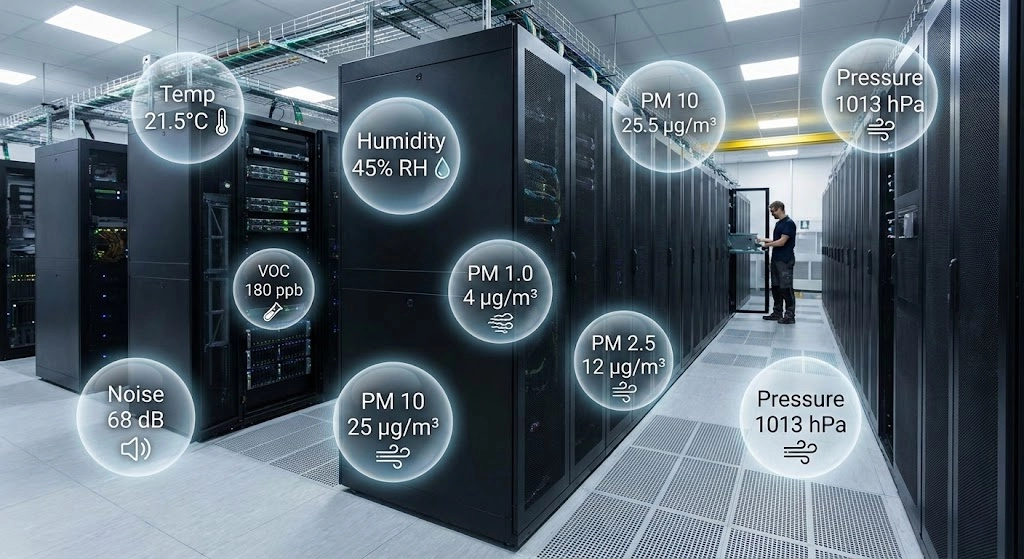


Indoor Air Quality in Data Centers: Why Clean Air Is Just as Important as Cooling
When people talk about data centers, temperature is usually the first thing mentioned. Keeping servers cool is essential, and modern data centers invest heavily in cooling systems to avoid overheating. But temperature alone does not tell the full story. A data center can be perfectly cool and still face serious long-term risks if the air inside the facility is polluted.
Indoor air quality plays a quiet but critical role in data center reliability. Dust, fine particles, chemical gases, and uncontrolled humidity can slowly damage IT equipment, reduce cooling efficiency, and increase maintenance costs. These problems rarely appear overnight. They build up over time, often without any obvious warning, until failures start to occur.
This is why indoor air quality monitoring should be seen as part of a data center’s reliability and risk-management strategy, not just an optional add-on.
Why temperature alone is not enough
Temperature measures how hot the air is, but it does not show what the air contains. In a data center, air constantly moves through servers, power supplies, cooling units, and filters. If that air carries dust or reactive gases, those contaminants eventually settle on sensitive electronic components.
Fine particles can block heatsinks and filters, forcing fans to work harder and increasing energy consumption. Over time, this reduces cooling efficiency and can create localized hotspots, even when room temperature looks normal.
Certain gases are even more problematic. Industry guidance from ASHRAE shows that reactive airborne contaminants can cause corrosion on electronic components, including copper and silver used on circuit boards. This type of damage is slow and difficult to detect, often showing up as unexplained failures or reduced equipment lifespan rather than sudden breakdowns.
ASHRAE has documented cases where contamination contributed to IT equipment issues, and it highlights that monitoring air quality makes it possible to take preventive action before damage occurs.
How modern cooling strategies increase the need for air quality monitoring
Many data centers now use energy-efficient cooling strategies such as increased outside-air intake or air-side economizers. These approaches can reduce energy costs, but they also increase exposure to outdoor pollution.
Traffic emissions, nearby construction, seasonal weather patterns, and industrial activity can all change outdoor air quality. When that air is drawn into a data center without proper monitoring, contaminants can enter the facility unnoticed.
This does not mean energy-efficient cooling is a bad idea. It means that cooling systems need feedback. Air quality data provides that feedback, allowing operators to balance energy efficiency with equipment protection.
Real-world problems that air quality monitoring helps prevent
Air quality issues in data centers often appear as patterns rather than single events. Operators may notice more frequent hardware replacements, unusual alarms, or inconsistent performance without a clear cause.
Corrosion-related failures are a well-known example. ASHRAE research explains that certain contamination conditions can lead to copper and silver corrosion on electronic components. Without monitoring, these conditions may go unnoticed for months. With monitoring, facilities can identify rising risk early and adjust ventilation or filtration before damage occurs.
Another common example is particulate buildup. A gradual increase in fine dust may not trigger temperature alarms, but it can slowly reduce cooling efficiency and increase wear on fans and filters. Trend data helps teams see these changes early, before they affect uptime.
During episodic events like wildfire smoke, particles can spike rapidly and overload filters, which is why “business as usual” maintenance schedules can fail during smoke events. Health Canada explicitly warns that wildfire particulate can quickly overload filters and increase system power requirements, making monitoring and responsive maintenance essential.
A common operational reality is that data centers will shut down or isolate systems when smoke is detected, even if the event is external or localized, because the risk of continuing is too high. In 2019, Wells Fargo experienced a major outage after smoke was detected at a data center facility, and services were disrupted at scale.
What air quality parameters matter in data centers
A practical air quality monitoring approach focuses on a small number of meaningful signals that together describe the health of the indoor environment.
Temperature and humidity remain essential because they directly affect server performance, electrostatic discharge risk, and corrosion potential. The difference is that they are monitored alongside other factors, not in isolation.
Particulate matter shows how clean the air is. Sudden spikes may indicate maintenance activity, door leakage, or outdoor pollution entering the facility. Long-term trends can reveal filtration problems or gradual ingress.
VOC measurements act as an early warning signal for unusual chemical exposure. These readings can change due to cleaning activities, building materials, or polluted outdoor air. In data centers, VOC data helps identify environmental changes that may increase corrosion risk.
Pressure measurements help verify airflow control and containment. Stable pressure supports clean airflow paths and reduces the chance of unfiltered air entering sensitive areas.
Noise data, while not a pollutant, can reflect changes in fan behavior and airflow resistance. Over time, it can support predictive maintenance by showing when systems are working harder than expected.
Why remote monitoring and trends matter
One-time measurements rarely reveal the full picture. Air quality problems often appear only when data is viewed over time.

Remote monitoring allows operators to see daily, weekly, and seasonal patterns. It becomes possible to answer practical questions such as when pollution spikes occur, whether certain HVAC modes increase exposure, or how air quality changes during maintenance or peak traffic hours.
Trend analysis turns air quality data into a decision-making tool rather than a static report. It supports proactive maintenance, better HVAC tuning, and faster root-cause analysis when problems appear.
Connecting air quality data to HVAC and building systems
Monitoring becomes even more powerful when air quality data is linked to HVAC, cooling systems, or a building management system.

If particulate levels rise, the system can increase filtration or temporarily reduce outside-air intake. If unusual VOC levels are detected, ventilation strategies can be adjusted or alerts sent to operators. If humidity drifts outside the preferred range, corrective action can be taken before corrosion or electrostatic risks increase.
ASHRAE guidance emphasizes that monitoring combined with preventive action is key to protecting IT equipment, especially when outdoor air is used for cooling.
How HibouAir supports data center air quality monitoring
HibouAir is designed for continuous indoor air quality monitoring and fits well into data center environments where reliability and visibility matter.
Devices such as the HibouAir Duo air quality monitor measure key environmental parameters in a compact form factor suitable for technical spaces. The collected data can be used locally or remotely, depending on operational needs.
HibouAir solutions support different deployment models, from standalone monitoring for individual rooms to cloud-based monitoring for multiple sites. This flexibility allows data center teams to start small and scale as needed, without changing their overall monitoring approach.
Because HibouAir focuses on long-term measurements and trend visibility, it supports preventive maintenance rather than reactive troubleshooting. It also provides the environmental data needed to integrate air quality into HVAC and building automation strategies.
In modern data centers, uptime depends on more than cooling capacity. It depends on how well the entire environment is controlled and understood. Indoor air quality monitoring adds a layer of protection that temperature alone cannot provide.
By measuring particles, gases, humidity, and related environmental signals over time, operators gain visibility into risks that would otherwise remain hidden. Combined with HVAC integration and automated responses, air quality monitoring helps data centers stay efficient, reliable, and resilient.
Clean air is not just about comfort. In data centers, it is part of protecting hardware, reducing risk, and ensuring long-term operational stability.