



Integrating Air Quality Monitoring into HVAC Control Strategies
Modern buildings are expected to do more than just maintain temperature – they must support health, productivity, and energy efficiency at the same time. For facility managers and HVAC engineers, this creates a balancing act. Ventilation must be sufficient to ensure good indoor air quality (IAQ), yet controlled enough to avoid unnecessary energy consumption.
This is where integrating air quality monitoring into HVAC control strategies becomes not just beneficial, but essential.
Moving Beyond Fixed Ventilation Approaches
Traditional HVAC systems often rely on static schedules or fixed ventilation rates. While simple to implement, these methods rarely reflect the actual conditions inside a building. A conference room may be empty but still fully ventilated, while a crowded classroom may not receive enough fresh air when it is needed most.
This mismatch leads to two common issues: over-ventilation, which wastes energy, and under-ventilation, which negatively impacts occupant health and comfort. Neither is acceptable in modern facility management.
By incorporating real-time air quality data, HVAC systems can shift from fixed operation to responsive control – adjusting airflow and system behavior based on actual demand.
The Role of Air Quality Data in HVAC Control
Air quality monitoring provides insight into what is happening inside a space at any given moment. Key parameters such as carbon dioxide (CO2), particulate matter (PM), volatile organic compounds (VOC), temperature, and humidity offer a clear picture of occupancy levels and pollutant buildup.
CO2, for example, is widely used as an indicator of ventilation effectiveness. Rising CO2 levels often signal inadequate fresh air supply in occupied spaces. Similarly, elevated particulate levels may indicate the need for filtration or increased air exchange, while VOC spikes can point to indoor pollution sources.
When these data points are continuously monitored, they can serve as real-time inputs for HVAC control systems, enabling smarter and more precise operation.
From Monitoring to Action: Closing the Control Loop
Collecting air quality data is only the first step. The real value lies in using that data to drive automated decisions.
An integrated approach allows HVAC systems to respond dynamically. As CO2 levels increase, ventilation rates can be adjusted automatically. When air quality improves, airflow can be reduced to conserve energy. This creates a closed-loop system where sensing, decision-making, and control work together seamlessly.
This is where solutions like HibouAir ControlHub® play a critical role. Instead of relying solely on dashboards or alerts, ControlHub® enables direct interaction between air quality measurements and physical HVAC systems. By applying predefined logic or thresholds, it can trigger actions such as adjusting ventilation rates, activating fans, or controlling dampers in real time.
The result is a system that does not just observe conditions – but actively maintains them.
Practical Integration in Real Environments
In office buildings, integrating air quality monitoring with HVAC control helps maintain consistent comfort throughout the day. Meeting rooms can automatically increase ventilation during use and scale back when empty, reducing unnecessary energy usage.
In educational settings, such as classrooms, maintaining optimal CO2 levels is directly linked to student concentration and performance. Automated ventilation ensures that air quality remains within acceptable limits without requiring manual intervention.
Industrial environments present a different challenge, where pollutants such as dust or chemical vapors may fluctuate throughout the day. Here, real-time monitoring allows ventilation and extraction systems to respond immediately to changes, improving both safety and operational efficiency.
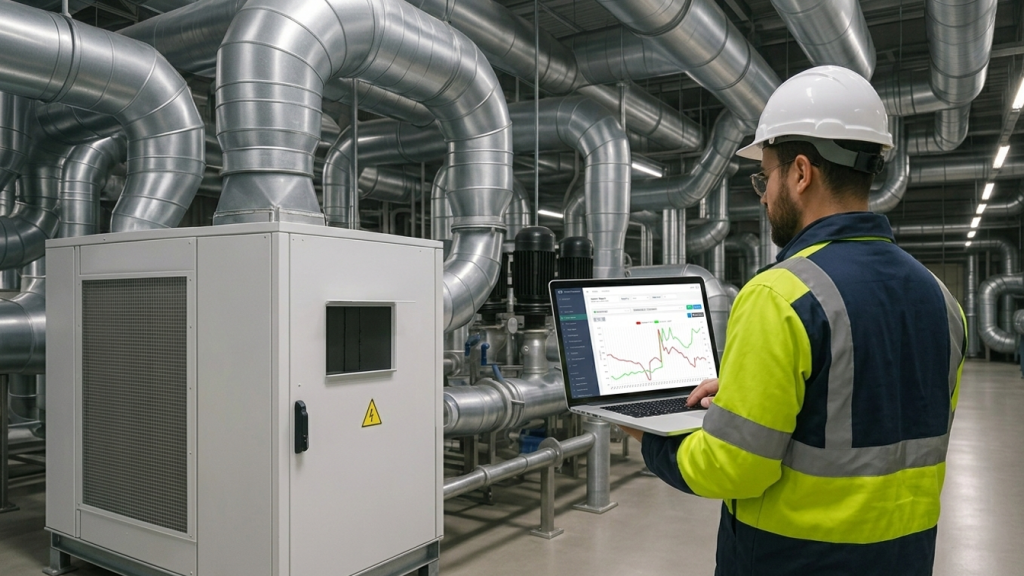
Healthcare facilities, where air quality requirements are stricter, also benefit from dynamic control. Continuous monitoring combined with automated response helps maintain stable conditions, supporting patient care and regulatory compliance.
Energy Efficiency Without Compromise
One of the most significant advantages of integrating air quality monitoring into HVAC control is the ability to optimize energy usage without sacrificing indoor conditions.
Demand-controlled ventilation (DCV) becomes far more effective when driven by accurate, real-time data. Instead of ventilating spaces based on assumptions, systems respond to actual needs. This reduces energy consumption associated with heating, cooling, and air distribution while still maintaining high air quality standards.
For facility managers, this translates into lower operational costs and improved sustainability performance, without the risk of compromising occupant wellbeing.
Integration with Existing Building Systems
A common concern is whether such integration requires a complete overhaul of existing infrastructure. In many cases, it does not. Modern solutions are designed to work alongside existing HVAC and building management systems (BMS), allowing facilities to enhance control without disrupting current operations.
Control interfaces such as analog outputs (e.g., 0–10V) and relay controls enable devices like ControlHub® to communicate directly with ventilation units, fans, and dampers for immediate, localized control. At the same time, integration with existing BMS platforms is made possible through industrial communication protocols such as Modbus.
With support for Modbus RTU and ASCII over RS485/RS422, ControlHub® can be connected directly into established building automation environments where Modbus is already in use. This allows air quality data and control signals to be shared seamlessly between systems, enabling centralized monitoring and coordinated control strategies across the facility.
The combination of local control and BMS integration provides flexibility for both quick deployment and large-scale implementations. Facilities can start with standalone operation and progressively integrate into their broader automation systems, upgrading their control strategies incrementally rather than replacing entire infrastructures.
As expectations for indoor environments continue to evolve, relying on static HVAC operation is no longer sufficient. Integrating air quality monitoring into control strategies allows buildings to respond dynamically, improving both occupant wellbeing and energy efficiency.