
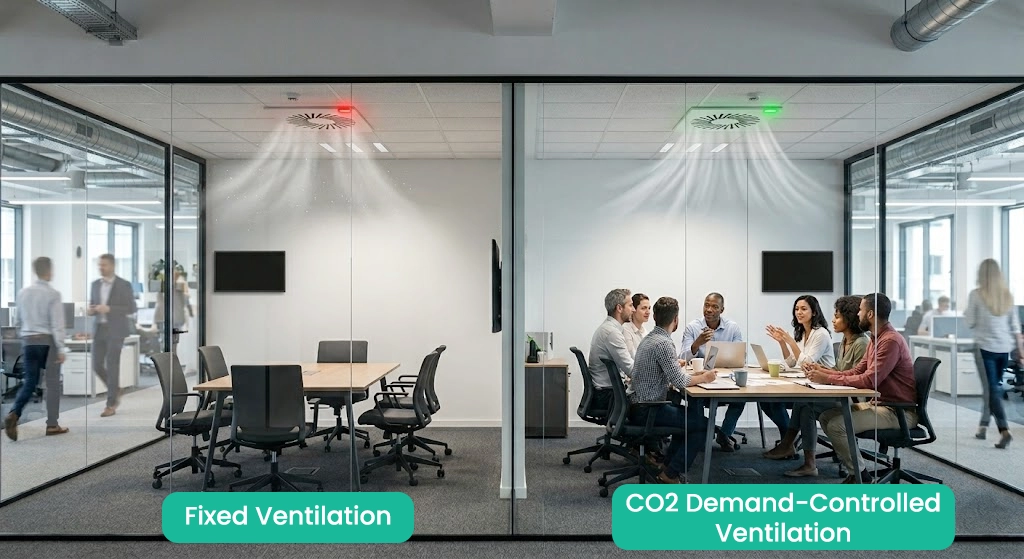


CO2 Demand-Controlled Ventilation vs Fixed Ventilation: Which Is Better?
Ventilation plays a major role in indoor comfort, air quality, and energy use. It removes stale air, brings in fresh air, and helps control indoor pollutants.
Many buildings still use fixed ventilation. The system runs at a preset fan speed, airflow rate, damper position, or schedule. This is simple, but it does not respond to what is actually happening inside the building.
A meeting room with two people does not need the same ventilation as a full meeting room. A classroom during a lesson does not need the same airflow after students leave. An office on a busy day does not need the same setting as an office with half the staff working remotely.
That is why CO2 demand-controlled ventilation is becoming a better option for many commercial buildings. With HibouAir CO2 Monitor or HibouAir DUO, buildings can measure real-time indoor air quality, while HibouAir ControlHub can use that data to support smarter ventilation control.
What Is Fixed Ventilation?
Fixed ventilation means the system operates based on a set condition. It may run during working hours, maintain a constant airflow rate, or keep fans and dampers at a fixed setting.
This approach is easy to understand and maintain. It can work in spaces with stable occupancy. But in buildings where occupancy changes throughout the day, fixed ventilation often creates two problems.
The first is under-ventilation. When more people are present than expected, CO2 levels rise and the air can feel stale or uncomfortable.
The second is over-ventilation. When rooms are empty or lightly occupied, the system may still bring in more outdoor air than needed. This increases heating, cooling, and energy demand.
What Is CO2 Demand-Controlled Ventilation?
CO2 demand-controlled ventilation uses real-time CO2 levels to adjust ventilation.
People exhale CO2 when they breathe. When more people occupy a room, or when fresh air supply is too low, CO2 levels increase. By monitoring CO2, a building can understand when a space needs more ventilation.
When CO2 rises above a selected threshold, the system can increase airflow by opening dampers, increasing fan speed, or activating ventilation equipment. When CO2 levels return to a better range, airflow can be reduced.
The goal is not to ventilate less. The goal is to ventilate based on actual demand.
The Problem with Fixed Ventilation
Fixed ventilation treats every day almost the same. But buildings are rarely used the same way every day.
Meeting rooms fill and empty. Offices have flexible work schedules. Restaurants have peak hours. Classrooms change between lessons and breaks. Hotels, clinics, gyms, and public buildings all experience changing occupancy.
When ventilation does not adjust, facility teams may face: High CO2 complaints, Stale or stuffy air, Unnecessary energy use, More difficult troubleshooting, Extra load on HVAC equipment etc
For facility managers and HVAC technicians, the biggest issue is lack of feedback. Without live indoor air quality data, it is hard to know whether a problem is caused by poor airflow, incorrect scheduling, blocked vents, damper issues, or high occupancy.
Where HibouAir Fits In
A smart ventilation strategy needs two things: reliable air quality data and a way to turn that data into action.
HibouAir CO2 Monitor provides real-time CO2 monitoring along with temperature, humidity, pressure, VOCs, and ambient light. It helps building teams understand how indoor conditions change during the day.
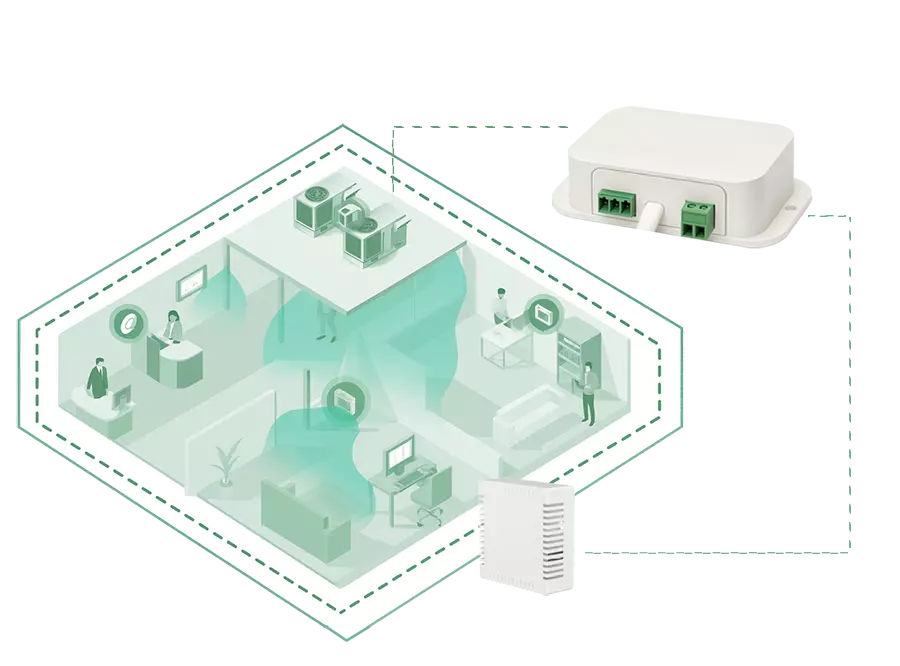
HibouAir DUO is suitable when a wider air quality picture is needed. It monitors CO2, PM1.0, PM2.5, PM10, VOC, temperature, humidity, and pressure. This is useful for offices, schools, healthcare spaces, commercial buildings, industrial facilities, and smart building projects.
HibouAir ControlHub connects monitoring to action. It can use data from HibouAir monitors and send control outputs to fans, dampers, HVAC controllers, or building automation systems.
For example, if CO2 rises in a meeting room, ControlHub can trigger more ventilation. When CO2 returns to a better level, ventilation can be reduced. This helps move the building from passive monitoring to automatic response.
Fixed Ventilation Still Has a Role
Fixed ventilation is not always wrong. Some spaces need constant airflow for safety, odor control, pressure control, or process requirements. This may include restrooms, kitchens, laboratories, healthcare areas, storage rooms, and some industrial spaces.
In many buildings, the best approach is a combination. A minimum ventilation rate can remain in place, while CO2 demand-controlled ventilation increases airflow when occupancy rises.
This gives the building a stable baseline with smarter response when needed.
Which Is Better?
CO2 demand-controlled ventilation is usually better for spaces with changing occupancy, comfort complaints, high energy costs, or limited visibility into ventilation performance.
Fixed ventilation may be enough for spaces with predictable use or where constant airflow is required. But for many modern buildings, fixed ventilation alone is too rigid.
The stronger question is: does the ventilation system understand what is happening inside the building?
If not, CO2 demand-controlled ventilation offers a clear improvement.
With HibouAir CO2 Monitor or HibouAir DUO, facility teams can measure indoor air quality in real time. With HibouAir ControlHub, that data can be used to control ventilation equipment and support smarter HVAC operation.
For facility managers, HVAC companies, and technicians, this means healthier indoor spaces, better comfort, lower energy waste, and more responsive buildings.