
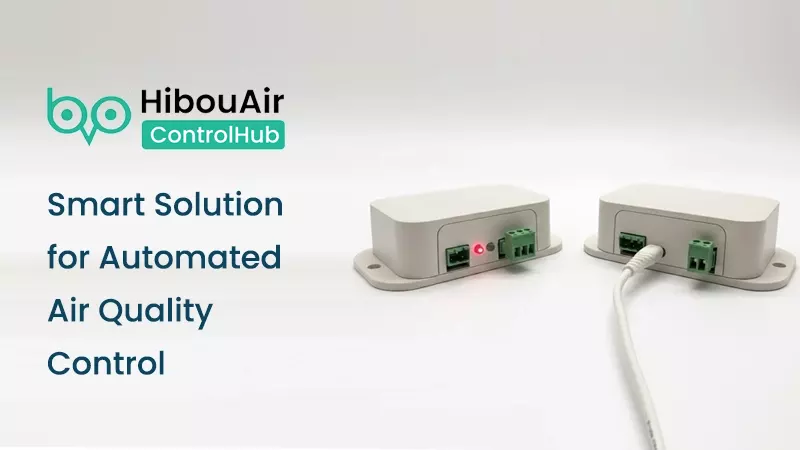
Introducing HibouAir ControlHub: Turning Air Quality Data into Smart Action

Indoor air quality has become a measurable priority—but monitoring alone is no longer enough. Modern buildings of today needs systems that can respond automatically to changing conditions, improve occupant comfort, saving energy, and do so without increasing operational costs. With this goal in mind, Smart Sensor Devices announces the release of HibouAir ControlHub, a new control solution designed to bridge the gap between air quality monitoring and real-world automation.

HibouAir ControlHub is built to work seamlessly with HibouAir air quality monitors, transforming environmental data into intelligent control signals for ventilation, HVAC, and building systems. The result is a practical, cost-effective approach to healthier indoor environments—without unnecessary complexity.

From Monitoring to Automation

Most indoor air quality systems stop at dashboards and alerts. While visibility is important, it still leaves building operators with a manual task: deciding when and how to act. HibouAir ControlHub changes this approach by enabling data-driven automation.

The ControlHub continuously reads air quality data—such as CO₂ levels, temperature, and humidity—from a selected HibouAir sensor and applies predefined control logic. When conditions exceed or return to set thresholds, the ControlHub automatically adjusts connected systems. Ventilation can increase when CO₂ rises, airflow can reduce when conditions normalize, and systems can operate only when needed.

This shift from passive monitoring to active control is what makes ControlHub especially valuable in modern buildings.

Technical Interface and Control Outputs

At the hardware level, HibouAir ControlHub is designed to plug directly into standard building control infrastructure. It offers two output options: a 0–10 VDC analog output for proportional control of ventilation, dampers, or VFD-driven fans, and an isolated 230VAC SPDT relay output (NC/NO) for robust on/off control of fans, extract systems, or alarms. For automation system integration, ControlHub supports Modbus RTU and Modbus ASCII over a dedicated RS485/422 serial port. Configuration can be done to set thresholds and control behavior locally via mobile application.

Where HibouAir ControlHub Makes the Biggest Impact

Offices and Commercial Buildings

In offices, rising CO₂ levels often indicate insufficient ventilation, leading to fatigue, reduced concentration, and complaints. HibouAir ControlHub enables demand-controlled ventilation by increasing airflow only when air quality degrades. This ensures healthier workspaces while avoiding constant full-power ventilation, keeping energy costs under control.

Schools and Educational Facilities

Classrooms experience rapid changes in air quality throughout the day. ControlHub allows ventilation systems to respond automatically to occupancy-driven CO₂ increases, helping maintain an environment that supports focus and learning—without relying on staff intervention.

Healthcare and Clinics

Healthcare environments require consistent air quality for both patients and staff. By reacting immediately to changes in air quality parameters, ControlHub helps maintain stable indoor conditions and supports infection-control strategies through improved ventilation management.

Industrial and Technical Spaces

In industrial settings, air quality fluctuations may occur due to processes, equipment, or occupancy changes. HibouAir ControlHub integrates easily with existing control infrastructure, providing a straightforward way to automate ventilation or extract systems based on real sensor data.

Smart Buildings and Energy-Efficient Retrofits

For building owners looking to upgrade existing systems, ControlHub offers a practical retrofit solution. It connects air quality intelligence to standard control inputs, enabling smarter operation without the need for full building management system replacements.

Cost-Effective Automation by Design

One of the key goals behind HibouAir ControlHub is efficient automation without complexity. Instead of adding layers of software or expensive centralized systems, ControlHub focuses on simple, local control.

By running ventilation and HVAC systems only when air quality requires it, buildings can significantly reduce unnecessary energy use. Fans and air handling units no longer operate at fixed schedules or maximum capacity by default. Over time, this demand-based approach contributes to lower energy bills, reduced equipment wear, and improved sustainability outcomes.

Because configuration is handled locally via Bluetooth, setup and adjustments can be made quickly—without specialized tools or ongoing cloud dependency.

A Natural Extension of the HibouAir Ecosystem

HibouAir ControlHub is designed as a natural extension of the HibouAir platform. While HibouAir monitors provide accurate, real-time insight into indoor environments, ControlHub completes the loop by enabling action.

Together, they form a complete solution – Measure indoor air quality precisely, define clear thresholds and control behavior, Automatically respond through connected systems. This approach ensures that air quality data does not remain passive but becomes an active driver of healthier indoor spaces.

Product Release and Availability

The release of HibouAir ControlHub marks an important step in Smart Sensor Devices’ commitment to practical indoor air quality solutions. With ControlHub, the focus moves beyond awareness toward measurable improvement, giving building operators a reliable tool to automate ventilation and HVAC responses based on real conditions.

HibouAir ControlHub is now available to pre-order as part of the HibouAir product range, offering a scalable and future-ready solution for offices, schools, healthcare facilities, and smart buildings of all sizes.

As indoor air quality standards continue to evolve, the need for responsive, efficient control will only grow. HibouAir ControlHub is designed to meet this need today—by making automation accessible, cost-effective, and driven by accurate sensor data.

For organizations looking to improve indoor environments while managing energy use responsibly, HibouAir ControlHub represents a clear next step in intelligent building operation.
Share this post on :

Indoor Air Quality in Call Centers: CO2, Noise, and Productivity in Dense Work Areas

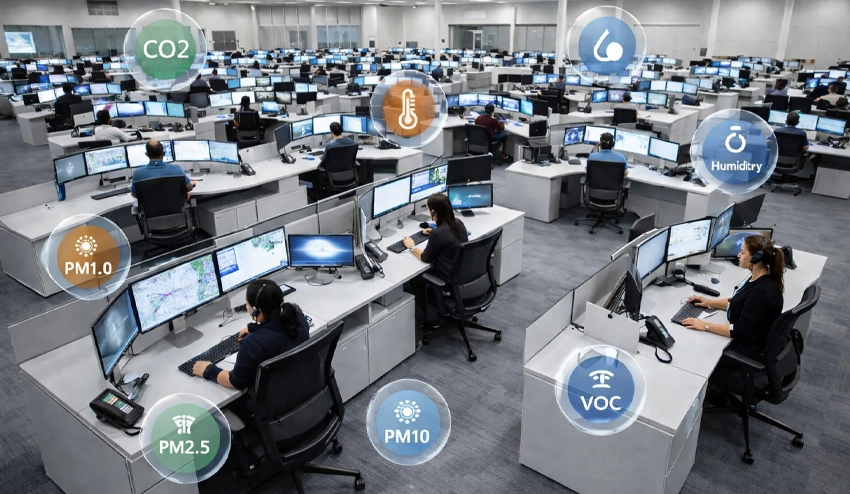
Call centers are designed for people, not machines. Hundreds of employees may work in the same space, often seated close together, speaking continuously, and spending long hours indoors. While most call centers pay attention to seating, lighting, and temperature, one critical factor is often overlooked: indoor air quality.

Poor air quality does not usually cause immediate failure, but it directly affects concentration, energy levels, communication quality, and overall productivity. In dense work environments like call centers, air quality issues can quietly reduce performance, increase fatigue, and contribute to higher absenteeism and staff turnover.

Monitoring indoor air quality helps make these invisible problems visible and gives facility teams the data they need to improve working conditions in a measurable way.

Why call centers are especially vulnerable to poor air quality

Unlike offices where people move around frequently, call centers have several characteristics that increase air quality risk. Occupancy density is high, people speak constantly, and many employees remain at their desks for extended periods. This leads to faster buildup of CO2 and higher noise levels, even when the room temperature feels comfortable.

Ventilation systems may not always adapt well to rapid changes in occupancy, such as peak shifts, overtime hours, or seasonal staffing increases. As a result, air quality can degrade during the day without anyone noticing until performance begins to drop.

Because these changes happen gradually, they are often mistaken for “normal tiredness” rather than environmental stress.

CO2 and cognitive performance in call centers

CO2 is one of the most important indicators of indoor air quality in call centers. CO2 itself is not toxic at typical indoor levels, but rising CO2 strongly indicates inadequate ventilation.

As CO2 levels increase, people commonly experience reduced concentration, slower reaction time, headaches, and mental fatigue. In a call center, this can lead to longer call handling times, more errors, reduced customer satisfaction, and increased stress for employees.

When CO2 is monitored continuously, it becomes clear how closely air quality follows occupancy and ventilation patterns. Teams can then adjust ventilation schedules or airflow based on real usage rather than fixed assumptions.

Noise: an overlooked environmental stress factor

Noise is a daily reality in call centers. Constant conversations, ringing phones, HVAC systems, and background equipment all contribute to sound levels that may not feel extreme but are persistent.

Over time, elevated noise increases stress, reduces speech clarity, and contributes to mental exhaustion. Employees may unconsciously raise their voices to compensate, further increasing noise levels across the room.

Monitoring noise does not replace acoustic treatment, but it provides valuable insight. Changes in noise patterns can indicate overcrowding, layout issues, or ventilation systems working harder than expected. Over time, noise trends can support better space planning and operational decisions.

Temperature and humidity still matter

Temperature comfort remains important in call centers, but comfort alone does not guarantee a healthy environment. A space can feel cool while still having high CO2 or poor ventilation.

Humidity also plays a role. Air that is too dry can cause throat irritation and vocal strain, especially in environments where employees speak continuously. High humidity, on the other hand, can increase discomfort and contribute to poor perceived air quality.

The key is to monitor temperature and humidity together with CO2 and noise, rather than treating them as separate issues.

Air quality problems are hard to spot without data

Most call center air quality issues do not trigger alarms. There is no obvious “failure moment.” Instead, performance declines slowly.

Supervisors may notice higher fatigue later in the day, more sick leave during certain seasons, or lower productivity during peak hours. Without environmental data, these patterns are often attributed to workload or staffing rather than indoor conditions.

Continuous air quality monitoring creates a clear picture. It shows when CO2 rises, how noise changes during shifts, and how temperature and humidity behave across the day. This makes it easier to separate environmental problems from operational ones.

Using trends to improve productivity and well-being

One of the biggest advantages of air quality monitoring is trend analysis. Instead of reacting to complaints, teams can proactively identify patterns.

For example, CO2 levels may rise sharply after lunch when the room refills, or during evening shifts when ventilation settings are reduced. Noise may peak during certain campaigns or seasonal hiring periods. These insights allow managers to adjust ventilation, staffing layout, or break schedules to reduce stress and maintain performance.

Over time, these small adjustments can improve productivity, reduce burnout, and support employee retention.

Integrating air quality monitoring with HVAC and BMS

Air quality monitoring becomes even more effective when it is connected to HVAC or building management systems.

If CO2 levels rise above a defined threshold, ventilation can automatically increase. If noise levels indicate overcrowding or system strain, alerts can prompt operational changes. If temperature or humidity drifts outside the comfort range, corrective action can be taken before complaints begin.

This type of integration turns air quality data into action, ensuring the indoor environment responds to real conditions rather than static schedules.

How HibouAir supports call center environments

HibouAir is designed for continuous indoor air quality monitoring in real working environments, including dense office spaces and call centers.

Devices such as the HibouAir Duo air quality monitor measure CO2, temperature, humidity, noise, particulate matter, and other relevant parameters in a single compact unit. This makes it easier to understand how different environmental factors interact throughout the day.

HibouAir supports both local and remote monitoring, allowing facility managers and operations teams to view air quality data across one or multiple call centers. Historical data and trends help teams make informed decisions rather than relying on assumptions or complaints.

Because HibouAir focuses on long-term visibility rather than one-time measurements, it supports gradual improvement of working conditions and better alignment between people, space, and ventilation systems.

Air quality as a productivity tool, not just a comfort feature

In call centers, productivity depends on people’s ability to focus, communicate clearly, and remain comfortable throughout long shifts. Indoor air quality directly affects all three.

By monitoring CO2, noise, temperature, and humidity, organizations gain a practical tool to improve performance, employee well-being, and operational efficiency. When air quality data is integrated with HVAC and building systems, the environment can adapt automatically to real usage.

Clean, well-managed air is not just about comfort in call centers. It is about supporting people so they can perform consistently, communicate effectively, and work in a healthier, more sustainable environment.

Share this post on :

Indoor Air Quality in Data Centers: Why Clean Air Is Just as Important as Cooling

When people talk about data centers, temperature is usually the first thing mentioned. Keeping servers cool is essential, and modern data centers invest heavily in cooling systems to avoid overheating. But temperature alone does not tell the full story. A data center can be perfectly cool and still face serious long-term risks if the air inside the facility is polluted.

Indoor air quality plays a quiet but critical role in data center reliability. Dust, fine particles, chemical gases, and uncontrolled humidity can slowly damage IT equipment, reduce cooling efficiency, and increase maintenance costs. These problems rarely appear overnight. They build up over time, often without any obvious warning, until failures start to occur.

This is why indoor air quality monitoring should be seen as part of a data center’s reliability and risk-management strategy, not just an optional add-on.

Why temperature alone is not enough

Temperature measures how hot the air is, but it does not show what the air contains. In a data center, air constantly moves through servers, power supplies, cooling units, and filters. If that air carries dust or reactive gases, those contaminants eventually settle on sensitive electronic components.

Fine particles can block heatsinks and filters, forcing fans to work harder and increasing energy consumption. Over time, this reduces cooling efficiency and can create localized hotspots, even when room temperature looks normal.

Certain gases are even more problematic. Industry guidance from ASHRAE shows that reactive airborne contaminants can cause corrosion on electronic components, including copper and silver used on circuit boards. This type of damage is slow and difficult to detect, often showing up as unexplained failures or reduced equipment lifespan rather than sudden breakdowns.

ASHRAE has documented cases where contamination contributed to IT equipment issues, and it highlights that monitoring air quality makes it possible to take preventive action before damage occurs.

How modern cooling strategies increase the need for air quality monitoring

Many data centers now use energy-efficient cooling strategies such as increased outside-air intake or air-side economizers. These approaches can reduce energy costs, but they also increase exposure to outdoor pollution.

Traffic emissions, nearby construction, seasonal weather patterns, and industrial activity can all change outdoor air quality. When that air is drawn into a data center without proper monitoring, contaminants can enter the facility unnoticed.

This does not mean energy-efficient cooling is a bad idea. It means that cooling systems need feedback. Air quality data provides that feedback, allowing operators to balance energy efficiency with equipment protection.

Real-world problems that air quality monitoring helps prevent

Air quality issues in data centers often appear as patterns rather than single events. Operators may notice more frequent hardware replacements, unusual alarms, or inconsistent performance without a clear cause.

Corrosion-related failures are a well-known example. ASHRAE research explains that certain contamination conditions can lead to copper and silver corrosion on electronic components. Without monitoring, these conditions may go unnoticed for months. With monitoring, facilities can identify rising risk early and adjust ventilation or filtration before damage occurs.

Another common example is particulate buildup. A gradual increase in fine dust may not trigger temperature alarms, but it can slowly reduce cooling efficiency and increase wear on fans and filters. Trend data helps teams see these changes early, before they affect uptime.

During episodic events like wildfire smoke, particles can spike rapidly and overload filters, which is why “business as usual” maintenance schedules can fail during smoke events. Health Canada explicitly warns that wildfire particulate can quickly overload filters and increase system power requirements, making monitoring and responsive maintenance essential.

A common operational reality is that data centers will shut down or isolate systems when smoke is detected, even if the event is external or localized, because the risk of continuing is too high. In 2019, Wells Fargo experienced a major outage after smoke was detected at a data center facility, and services were disrupted at scale.

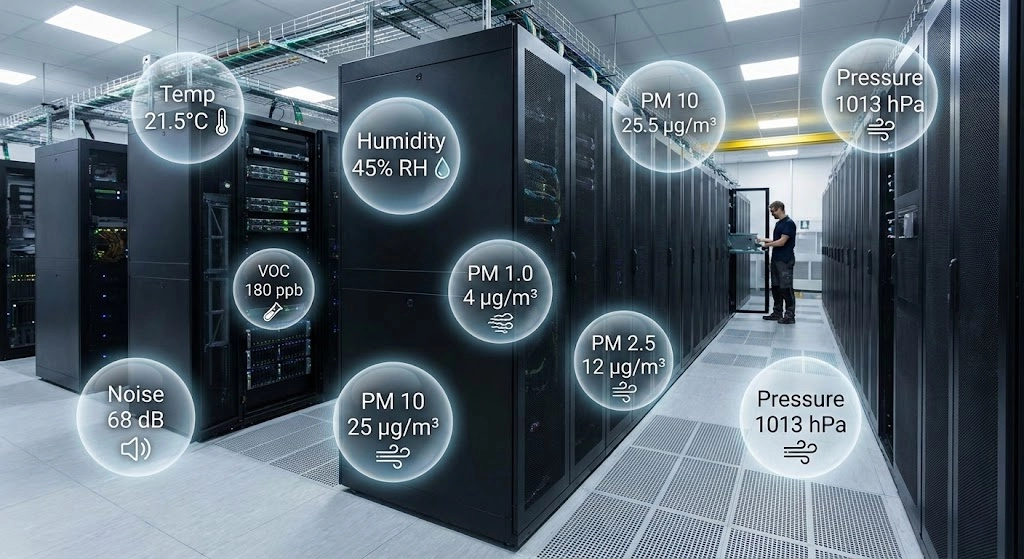
What air quality parameters matter in data centers

A practical air quality monitoring approach focuses on a small number of meaningful signals that together describe the health of the indoor environment.

Temperature and humidity remain essential because they directly affect server performance, electrostatic discharge risk, and corrosion potential. The difference is that they are monitored alongside other factors, not in isolation.

Particulate matter shows how clean the air is. Sudden spikes may indicate maintenance activity, door leakage, or outdoor pollution entering the facility. Long-term trends can reveal filtration problems or gradual ingress.

VOC measurements act as an early warning signal for unusual chemical exposure. These readings can change due to cleaning activities, building materials, or polluted outdoor air. In data centers, VOC data helps identify environmental changes that may increase corrosion risk.

Pressure measurements help verify airflow control and containment. Stable pressure supports clean airflow paths and reduces the chance of unfiltered air entering sensitive areas.

Noise data, while not a pollutant, can reflect changes in fan behavior and airflow resistance. Over time, it can support predictive maintenance by showing when systems are working harder than expected.

Why remote monitoring and trends matter

One-time measurements rarely reveal the full picture. Air quality problems often appear only when data is viewed over time.

Remote monitoring allows operators to see daily, weekly, and seasonal patterns. It becomes possible to answer practical questions such as when pollution spikes occur, whether certain HVAC modes increase exposure, or how air quality changes during maintenance or peak traffic hours.

Trend analysis turns air quality data into a decision-making tool rather than a static report. It supports proactive maintenance, better HVAC tuning, and faster root-cause analysis when problems appear.

Connecting air quality data to HVAC and building systems

Monitoring becomes even more powerful when air quality data is linked to HVAC, cooling systems, or a building management system.

If particulate levels rise, the system can increase filtration or temporarily reduce outside-air intake. If unusual VOC levels are detected, ventilation strategies can be adjusted or alerts sent to operators. If humidity drifts outside the preferred range, corrective action can be taken before corrosion or electrostatic risks increase.

ASHRAE guidance emphasizes that monitoring combined with preventive action is key to protecting IT equipment, especially when outdoor air is used for cooling.

How HibouAir supports data center air quality monitoring

HibouAir is designed for continuous indoor air quality monitoring and fits well into data center environments where reliability and visibility matter.

Devices such as the HibouAir Duo air quality monitor measure key environmental parameters in a compact form factor suitable for technical spaces. The collected data can be used locally or remotely, depending on operational needs.

HibouAir solutions support different deployment models, from standalone monitoring for individual rooms to cloud-based monitoring for multiple sites. This flexibility allows data center teams to start small and scale as needed, without changing their overall monitoring approach.

Because HibouAir focuses on long-term measurements and trend visibility, it supports preventive maintenance rather than reactive troubleshooting. It also provides the environmental data needed to integrate air quality into HVAC and building automation strategies.

In modern data centers, uptime depends on more than cooling capacity. It depends on how well the entire environment is controlled and understood. Indoor air quality monitoring adds a layer of protection that temperature alone cannot provide.

By measuring particles, gases, humidity, and related environmental signals over time, operators gain visibility into risks that would otherwise remain hidden. Combined with HVAC integration and automated responses, air quality monitoring helps data centers stay efficient, reliable, and resilient.

Clean air is not just about comfort. In data centers, it is part of protecting hardware, reducing risk, and ensuring long-term operational stability.

Share this post on :

Contact Us

Call us or simply fill out the form below, and one of our representatives will get back to you as soon as possible.