


CO₂ Is Fine but the Air Still Feels Bad—What Else Should You Measure?
CO₂ is often the first measurement people look at when they want to understand indoor air quality. That makes sense. In occupied spaces, rising CO₂ can be a useful sign that ventilation is not keeping up with the number of people in the room. But CO₂ is only one part of the indoor environment.
A room can show an acceptable CO₂ level and still feel uncomfortable, stale or unpleasant. People may complain about headaches, dry air, unusual smells, dust or a heavy feeling in the room even though the CO₂ monitor suggests that ventilation is working properly. This is where relying on a single measurement can become misleading.
Indoor air quality is influenced by several factors at the same time. Understanding what is actually happening often requires looking beyond CO₂ and seeing how different environmental parameters behave together.
Good CO₂ does not necessarily mean good indoor air
Imagine an office where CO₂ remains at a reasonable level throughout the day. From a ventilation perspective, this may initially look positive. However, employees still complain that the air feels uncomfortable in the afternoon.
There could be many reasons. Fine particles may be entering from outside traffic. Cleaning products may be increasing VOC levels. Humidity may have fallen too low. Furniture, paint or other materials may be releasing pollutants. The room may simply be getting too warm as occupancy and equipment generate heat. None of these problems would necessarily appear in the CO₂ data.
CO₂ mainly tells us something about occupancy and ventilation effectiveness in relation to people. It does not directly tell us whether particles, VOC, humidity or temperature are creating another indoor environmental problem. This is why a wider view of the room is often needed.
The real value comes from seeing parameters together
Different measurements can reveal very different problems in the same room.
Particulate matter can show pollution entering from outdoors or being generated indoors through cleaning, cooking, printing or dust movement. VOC measurements can reveal changes linked to cleaning products, furniture, flooring, paints or other materials. Temperature and humidity help explain discomfort that may have little to do with CO₂ at all.
For example, a room may have acceptable CO₂ while PM2.5 rises because outdoor pollution is entering through the ventilation system. Another room may show low CO₂ but experience a VOC increase after cleaning. In a meeting room, CO₂ may remain under control while the temperature gradually rises and occupants begin to describe the space as stuffy.
Looking at these measurements together gives much more context than looking at one value alone.
Why HibouAir Duo is useful for this type of investigation
This is one of the reasons Smart Sensor Devices developed the HibouAir Duo.
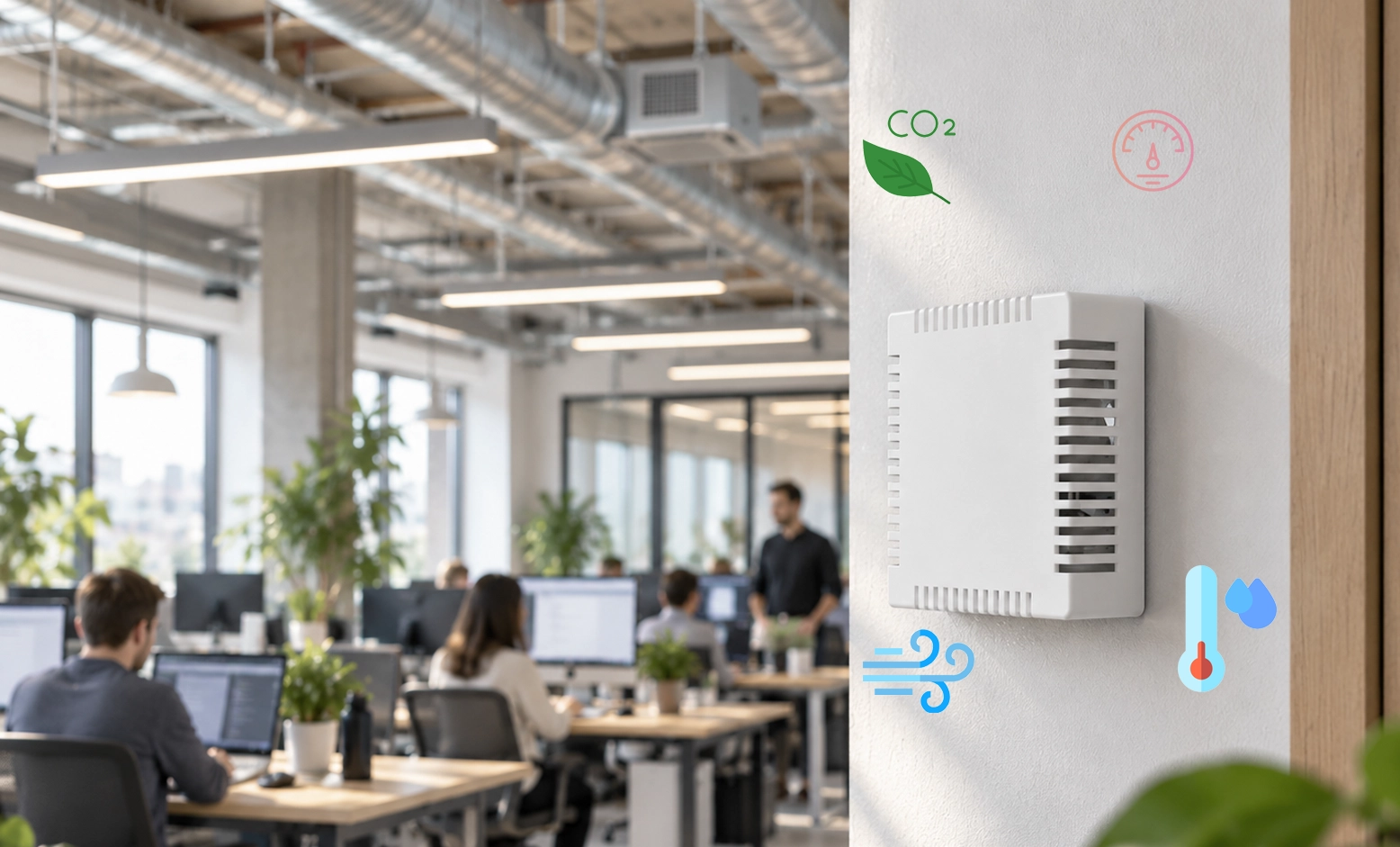
Instead of looking only at CO₂, HibouAir Duo brings several important indoor environmental measurements together in one monitoring device. It can monitor CO₂ alongside particulate matter including PM1.0, PM2.5 and PM10, as well as VOC, temperature, humidity and pressure.
This makes it easier to investigate situations where the obvious measurement does not explain what occupants are experiencing. If somebody says that a room feels bad even though CO₂ looks normal, the answer does not have to be based on guesswork. You can look at what else was happening at the same time.
Having these measurements together provides context that a single CO₂ sensor cannot provide.
Real-time and historical data help reveal the full picture
Real-time monitoring is useful when the problem is happening at that moment. If people suddenly complain that a room feels uncomfortable, current readings can immediately show whether CO₂, PM, VOC, temperature or humidity has changed.
Historical data becomes even more valuable when the problem is temporary or recurring. Many indoor air quality issues appear only at certain times. A VOC spike may happen after cleaning. PM levels may increase during morning traffic. Temperature may rise every afternoon. CO₂₂ may only become elevated during certain meetings or classes.
By reviewing previous measurements, building operators can identify these patterns instead of relying on a single snapshot. This makes it possible not only to see what is happening now, but also to understand what repeatedly happens in the room over time.
From one number to a complete picture
Indoor air quality is rarely explained by one measurement. A room can have acceptable CO₂ and still have high particulate matter. It can have low CO₂ and elevated VOC levels. It can have good pollutant readings but still feel uncomfortable because temperature or humidity is outside the preferred range.
That is why multi-parameter monitoring is valuable.
With HibouAir Duo, several important indoor environmental parameters can be monitored together, while real-time and historical data help reveal both immediate events and recurring patterns.