
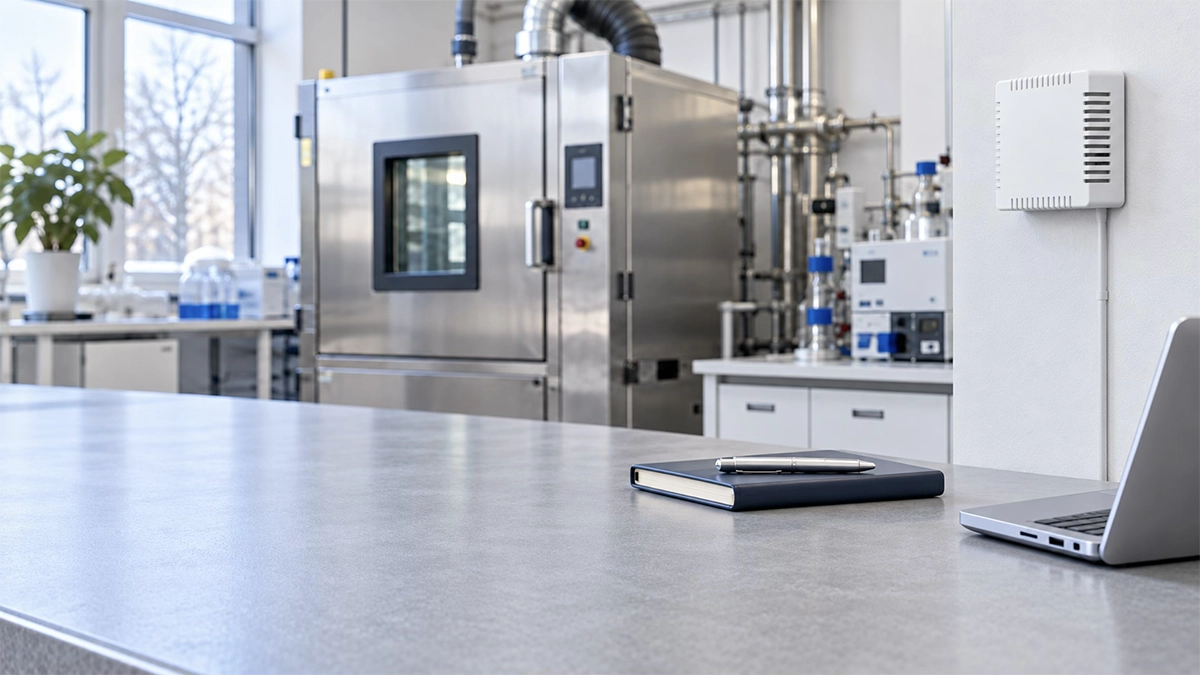
Ozone Monitoring with HibouAir DUO Extended O3
Ozone may be relevant to an indoor environment even when CO2 and particle readings appear unremarkable. For teams investigating ozone-related processes or assessing indoor air, the practical question is straightforward: what concentration is present at the measurement location, and how does it change over time?
HibouAir DUO Extended O3 adds a dedicated ozone channel to a broader set of indoor environmental measurements. It helps teams document ozone trends and investigate them alongside CO2, particles, temperature and humidity.
Why Ozone Deserves Attention
Ozone, O3, is a reactive gas made up of three oxygen atoms. In the upper atmosphere, it helps protect the Earth from ultraviolet radiation. In the air we breathe, however, ozone can harm the respiratory system.
Ozone can enter buildings from outdoors, and some equipment can produce it indoors. Where ozone-generating equipment is present, understanding the surrounding air requires attention to the actual concentration rather than assumptions about the process.
Generator Output Is Not Room Concentration
One useful distinction is the difference between ozone production and ozone concentration. A generator’s output in milligrams per hour describes how much ozone it produces. It does not directly state how much ozone is present in the air at a particular location.
Airborne concentration is often expressed in parts per million, or ppm. The concentration that develops depends on factors such as room size, air exchange, equipment output and reactions with indoor surfaces and substances. A generator specification therefore cannot substitute for measuring the environment.
For an investigation team, that distinction changes the questions to ask: Are readings different across locations? Do they change when equipment operates? What happens after ventilation is adjusted?
Health Effects Depend on Exposure
Breathing ozone can cause coughing, throat irritation, chest discomfort and shortness of breath. It can also aggravate asthma. The effects depend on concentration, exposure duration, activity level and individual susceptibility.
The smell of ozone cannot reliably establish that a space is safe. Neither a treatment timer nor an assumed decay period provides a universal basis for re-entry. Where ozone treatment is carried out, access control, ventilation and suitable verification must follow the site’s risk assessment and applicable requirements.
Environmental trend monitoring can support an investigation. Any decision about personnel protection or re-entry requires equipment and procedures demonstrated to be suitable for that purpose.
More Context in Each Monitoring Study
HibouAir DUO Extended O3, model SSD002/4B-6, measures ozone over a range of 0–5 ppm, with a stated resolution below 0.01 ppm. It also measures CO2, PM1.0, PM2.5, PM10, temperature and relative humidity.
A built-in data logger provides storage intervals programmable in one-minute steps. Depending on the selected interval, readings can be stored for days, weeks or months. Historical measurements and PDF reports support analysis and documentation.
These measurements provide context for an ozone study. For example, a team can compare ozone trends with equipment operating records and review whether temperature, humidity or particle readings changed during the same period. Such comparisons help guide further investigation; they do not by themselves establish the cause of a change.
Turning Observations into Practical Decisions
Environmental laboratories, indoor assessment teams and facility managers can use a monitoring plan to define where and when data should be collected with the help of air quality monitoring device. Recording equipment operation, ventilation changes and measurement locations makes that data easier to interpret.
A useful study begins with a specific question and leads to a specific next step: investigate a possible source, review ventilation performance or arrange a more detailed assessment. HibouAir DUO Extended O3 provides a measurement record to support that work.
Contact HibouAir to discuss ozone monitoring, measurement locations and the configuration that suits your project.
Sources
- US EPA, Ozone Generators that are Sold as Air Cleaners: https://www.epa.gov/indoor-air-quality-iaq/ozone-generators-are-sold-air-cleaners
- US EPA, Health Effects of Ozone Pollution: https://www.epa.gov/ground-level-ozone-pollution/health-effects-ozone-pollution