
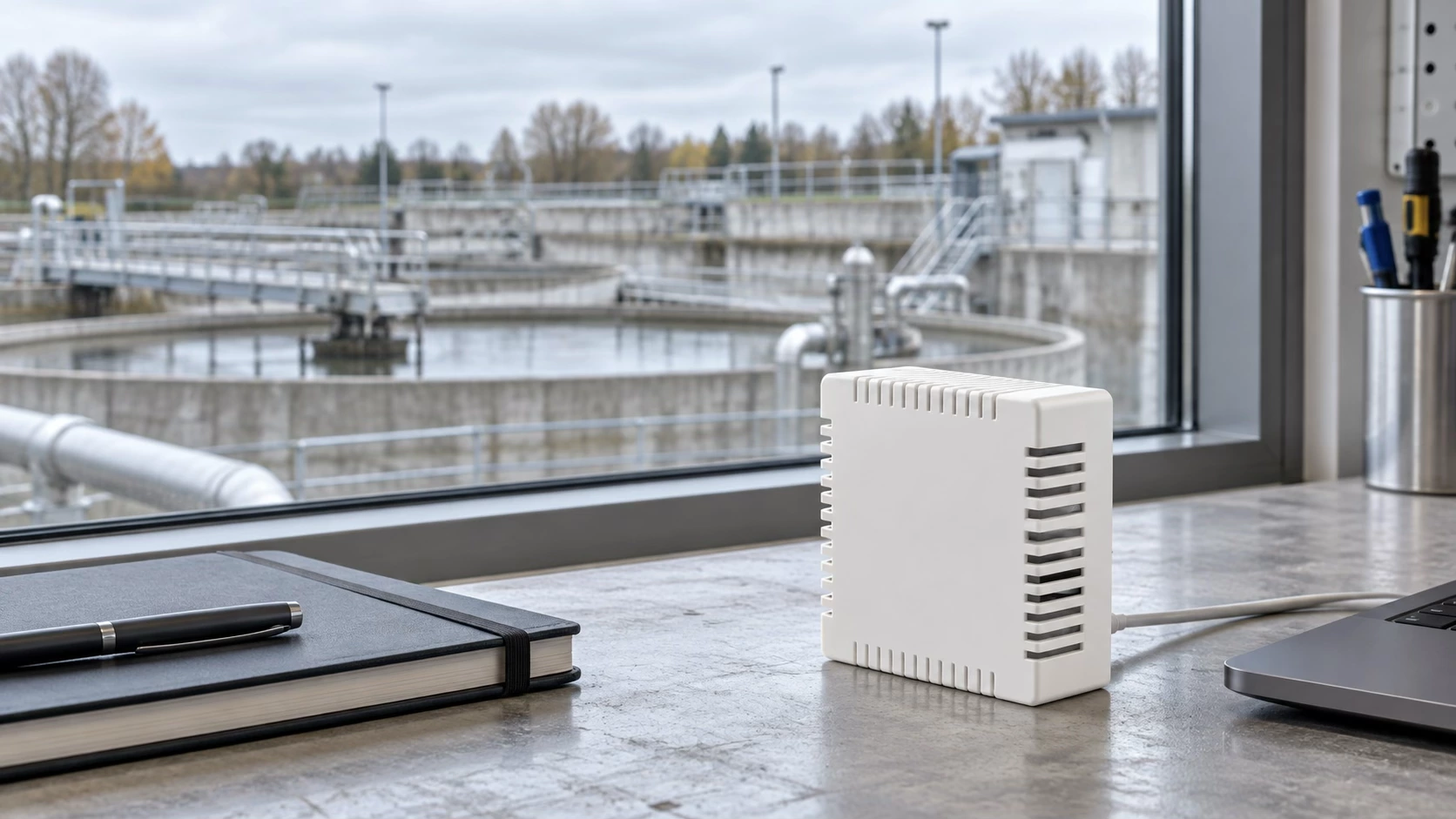


Hydrogen Sulphide in Wastewater Environments – Better Maintenance Starts with Measurement Data
Hydrogen sulphide presents a challenge for both workplace health and the service life of facilities that handle wastewater. For those responsible for shipboard blackwater tanks, wastewater storage tanks or treatment plants, the issue goes beyond unpleasant odours. It also involves understanding conditions that can contribute to corrosion and extensive maintenance.
With HibouAir DUO Extended H₂S, we are expanding the ability to monitor hydrogen sulphide alongside other environmental parameters. This gives operations and maintenance teams a broader basis for investigating their environment and planning action.
Why Does Hydrogen Sulphide Form?
Hydrogen sulphide, H₂S, can form when organic matter breaks down under oxygen-deficient conditions. This makes the gas relevant to wastewater systems, tanks and wastewater treatment facilities. Stagnant water and poor ventilation can contribute to problems. The gas is heavier than air and can accumulate in low-lying and confined spaces.
Corrosion That Requires Extensive Repairs
In moist wastewater environments, hydrogen sulphide can contribute to corrosive processes. When the gas is oxidised, including through microbial activity on moist surfaces, sulphuric acid can form and attack concrete. Metal components can also be affected by corrosion associated with hydrogen sulphide.
Experience in corrosion protection shows how extensive maintenance can become. Blackwater tanks on ships may require protective coatings. In a large concrete wastewater tank, the work may involve repairs with epoxy mortar followed by a spray-applied coating throughout the tank.
These interventions naturally raise further questions about operating conditions: Where is hydrogen sulphide present? When do concentrations change? Which areas need closer investigation?
From Individual Readings to Better Maintenance Decisions
Measurements over time can help maintenance teams investigate recurring patterns and compare conditions before and after an intervention. Together with operating logs and inspections, this information can help prioritise further investigation.
On a ship, for example, a monitoring study could focus on relevant spaces near the blackwater system. At a wastewater treatment plant or biogas facility, similar questions may concern areas around wastewater handling and process equipment. Measurement locations and equipment need to be selected according to the environment and the local risk assessment.
H₂S measurements show gas conditions at the measurement location. Assessing corrosion and the condition of protective coatings also requires material assessment and inspection.
Health Risks Make Measurement Particularly Important
Hydrogen sulphide is a colourless, flammable gas that can cause severe poisoning. High concentrations can lead to collapse, breathing difficulties and death within minutes. Health effects depend on factors including concentration and the duration of exposure.
The smell of rotten eggs is not a reliable safety indicator. At high concentrations, the sense of smell can be lost. The disappearance of the odour therefore does not mean that the danger has passed.
Work in tanks and other confined spaces requires specific safety procedures and appropriate gas detection. Environmental monitoring should be treated as a complement to the protective systems and procedures required by the site’s risk assessment.
HibouAir DUO Extended H₂S – Gas Measurement with More Context
HibouAir DUO Extended H₂S combines hydrogen sulphide measurement with CO₂, PM1.0, PM2.5, PM10, temperature and relative humidity. The H₂S channel has a measurement range of 0–100 ppm and a resolution of 0.01 ppm.
A built-in data logger offers storage intervals programmable in one-minute steps. This makes it possible to revisit historical measurements and investigate how gas levels change alongside other environmental parameters.
For operations and maintenance teams, this provides a way to document conditions and build a basis for further analysis. The value comes when measurement data informs concrete decisions about investigation, ventilation and maintenance.
Want to investigate H₂S in your operations? Contact HibouAir to discuss measurement needs, placement and the solution that fits your environment.