


The Particles We Live With: Why PM Monitoring Belongs at the Centre of Indoor Air Quality
Indoor air quality is often discussed through the language of ventilation rates, carbon dioxide, odours, humidity or thermal comfort. These are important indicators, but one of the most important pollutants in indoor spaces is often invisible: particulate matter. Particulate matter, usually shortened to PM, is not one single substance. It is a broad description of tiny solid particles and liquid droplets suspended in air. These particles can vary in size, shape and composition, and they can come from both outdoor and indoor sources.
Particulate matter warrants attention because it is inhaled by people every day. Larger particles may settle as visible dust, while smaller particles can remain airborne for longer and be inhaled more deeply. Air-quality guidance commonly focuses on PM10, particles with diameters of 10 micrometres and smaller, and PM2.5, particles with diameters of 2.5 micrometres and smaller. These two size fractions are widely used because particle size affects how particles behave in air and where they may deposit in the respiratory system.
The World Health Organization’s 2021 global air quality guidelines brought renewed attention to particulate matter. WHO’s updated guidance covers particulate matter PM2.5 and PM10, ozone, nitrogen dioxide, sulfur dioxide and carbon monoxide. For indoor environments, this matters because people are not exposed only to the air outside. They are exposed to the air in homes, offices, classrooms, hospitals, aged-care facilities, commercial kitchens, workshops and public buildings.
Particulate matter is therefore not only an outdoor pollution problem. It is also a building-management problem. Outdoor pollution can enter buildings, and indoor activities can generate particles directly inside the occupied space. A room may look clean and still experience repeated fine-particle peaks. A building may feel comfortable but still have poor particle control during cooking, cleaning, high occupancy, smoke events or ventilation changes. Without measurement, these patterns often remain hidden.
Why indoor particulate matter is different from outdoor PM
Outdoor air pollution is measured by public monitoring networks in many cities, but indoor exposure is shaped by each building. PM found indoors can include particles that come from outdoor air and particles that are generated indoors. Outdoor particles may enter through windows and doors, mechanical ventilation, or small openings and cracks in the building envelope. Once inside, they may remain airborne, deposit on surfaces, become trapped by filters, or be resuspended by activity.
For Australia and other regions affected by smoke events, this distinction is particularly important. During bushfire smoke episodes, staying indoors may reduce exposure, but buildings are not automatically protective unless they are well sealed, filtered and managed. Indoor PM control therefore depends not only on what is happening outdoors, but also on how the building is operated.
Indoor-generated particles add another layer of complexity. Indoor PM sources can include cooking, some cleaning activities, combustion activities, biological contaminants, printers and indoor chemical reactions. This means that even when outdoor air is relatively clean, a building can still experience high particle levels because of what is happening inside.
Indoor PM can also be more personal and more variable than outdoor PM. One classroom may be affected by dust from movement and cleaning. One office may be affected by printing and poor filtration. One home may experience high cooking-related PM2.5 every evening. One care facility may have vulnerable occupants and require closer control. Public outdoor data cannot explain all of these local indoor patterns. Indoor monitoring can.
PM1.0, PM2.5 and PM10: why particle size matters
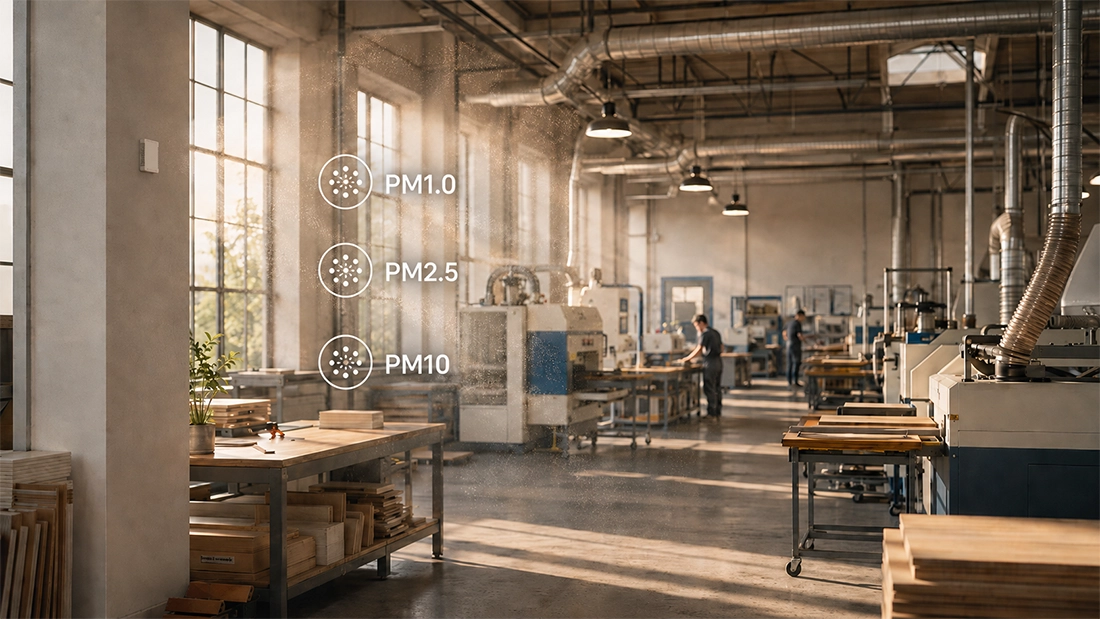
Most indoor PM monitors report one or more particle-size fractions. PM10 represents inhalable particles with an aerodynamic diameter of 10 micrometres or smaller. PM2.5 represents fine particles 2.5 micrometres or smaller. PM1.0 represents particles 1 micrometre or smaller. Each fraction can help describe a different aspect of indoor particle behaviour.
PM10 is often useful for identifying larger dust and coarse-particle events. These may be linked to cleaning, human movement, outdoor dust, pollen fragments, building work, carpets or soft furnishings. PM2.5 is especially important because fine particles are commonly associated with combustion, smoke and cooking aerosols. PM1.0 can provide additional insight into smaller fine-particle changes, although it should be interpreted carefully because regulations and health guidance most commonly use PM2.5 and PM10.
Particle size affects how particles move and how long they remain airborne. Larger particles tend to settle faster. Smaller particles can remain suspended longer and travel further with indoor air movement. This makes fine particles particularly important in occupied rooms, open-plan spaces and buildings where air is recirculated.
A PM monitor cannot always identify the exact chemical composition of the particles. However, it can show timing, location, intensity and recovery. A PM10 increase after vacuuming may suggest dust resuspension. A PM2.5 rise during cooking may indicate fine cooking aerosols. A rise during a smoke event may suggest outdoor infiltration. These patterns are often enough to guide practical action.
Common sources of indoor particulate matter
Cooking is one of the most common indoor particle sources. Frying, grilling, roasting, toasting and high-temperature cooking can produce short but intense PM peaks. The size and composition of cooking particles can depend on the food, oil, temperature, cooking method, fuel type, ventilation and duration.
Combustion is another important source. Burning candles, using fireplaces, operating unvented heaters, smoking products and similar combustion activities can all generate particles. This makes PM relevant not only to obvious pollution sources but also to everyday lifestyle choices.
Dust is also more complex than it appears. Settled dust can contain soil, fibres, biological material, skin flakes, pollen, pet dander, mould fragments, particles from cooking or combustion, and residues from consumer products. People walking, children playing, moving furniture, sweeping or vacuuming with poor filtration can all resuspend particles.
Biological contaminants are another part of the particle story. Animals, pests, plants and mould can all contribute to airborne biological particles. In damp buildings, mould fragments and spores may contribute to airborne particles and signal a larger moisture problem. In spaces with pets or pests, biological particles may be a recurring contributor to indoor particulate matter.
Office equipment and hobbies can matter too. Printers and copiers may contribute to indoor particle levels in some office environments. Hobbies and maintenance activities such as sanding, woodworking, crafting, 3D printing, drilling and renovation can also release particles. In commercial or school environments, these activities may not happen constantly, but when they do, they can produce noticeable particle events.
Why measurement changes behaviour
PM monitoring makes invisible events visible. This is the central value of a PM sensor. People may not see or smell fine particles. A room can feel normal while PM2.5 has risen significantly. By showing real-time changes, monitoring helps occupants and building managers connect air quality with activities.
In a home, a monitor may show how much a frying event changes PM2.5 levels and how long the room takes to recover. In a school, it may show whether outdoor pollution enters classrooms at certain times of day. In an office, it may be revealed that particle levels rise during cleaning, printing or high-occupancy periods. In a healthcare or age-care setting, it can support greater awareness for sensitive occupants.
Monitoring also helps evaluate interventions. If a building changes filters, adds portable air cleaners, improves kitchen extraction or changes cleaning procedures, PM data can show whether the change worked. Without data, decisions may rely on smell, comfort or assumption. With data, building teams can compare before and after conditions.
Continuous PM monitoring is important because particulate matter levels can change rapidly throughout the day due to traffic, cooking, industrial activity, ventilation changes, weather, or indoor activities. A single measurement may miss short-term pollution spikes that still affect health.
PM limits levels are defined in a daily average, that’s the reason continuous monitoring during the day is necessary to tracks the baseline levels.
It is also a way to identify patterns that matter: repeated peaks, high baseline levels, slow recovery, room-to-room differences, outdoor infiltration, or particle events linked to specific activities.
Ventilation, filtration and source control
The first step in reducing indoor PM is source control. If a source can be removed, reduced or isolated, that is often better than trying to remove the particles after they are airborne. Examples include reducing combustion sources, using effective cooking extraction, maintaining appliances, controlling moisture, avoiding unnecessary dust generation, and improving cleaning methods.
Ventilation is essential for indoor air quality, but it must be used intelligently. Ventilation can dilute indoor-generated particles when outdoor air is clean. But when outdoor air contains smoke, traffic pollution or dust, ventilation without suitable filtration can bring more PM indoors. This is why PM monitoring should be considered alongside outdoor conditions, filtration and building operation.
Filtration is one of the most practical PM control strategies. HVAC filters, portable air cleaners and local extraction systems can reduce particle levels when they are properly selected, sized, maintained and operated. ASHRAE describes Standards 62.1 and 62.2 as standards for ventilation system design and acceptable indoor air quality in residential and commercial buildings. In practice, filter performance, air-change patterns and maintenance determine whether a system actually reduces occupant exposure.
Good PM control usually combines all three approaches: source control, ventilation and filtration. Monitoring helps determine which approach is needed. If PM rises because of indoor cooking, source control and extraction may be most effective. If PM rises because of outdoor smoke, sealing and filtration may matter more. If PM stays high after an event, air cleaning or ventilation strategy may need improvement.
What compact PM sensors do well, and where caution is needed
Compact PM sensors have made air-quality monitoring more accessible. Many modern PM devices use optical sensing methods to estimate particle mass concentration. They can show changes quickly, support continuous monitoring and be deployed across many rooms at lower cost than reference-grade instruments.
However, compact and low-cost PM sensors must be interpreted properly. A review in the Journal of Aerosol Science states that low-cost particulate matter sensors enable spatially dense, high-temporal-resolution air quality measurements. This is valuable, but sensor data quality can still depend on calibration, particle type, humidity, bias correction and the intended use.
This does not mean compact PM monitors are not useful. It means users should understand their role. They are excellent for trend monitoring, event detection, room comparison, awareness, alerts and operational decision-making. Formal compliance or scientific assessment may require reference-grade methods or validated monitoring protocols.
For most buildings, trend intelligence is extremely valuable. If one room repeatedly has higher PM than others, if a filter change reduces PM peaks, if a kitchen takes two hours to recover after cooking, or if a classroom is affected by outdoor traffic at drop-off time, that information can guide real improvements.
PM monitoring in homes, schools and workplaces
In homes, PM monitoring can help occupants understand the effect of cooking, candles, fireplaces, cleaning, pets, dust, outdoor smoke and ventilation choices. This is especially useful for households with children, older adults or people with asthma, allergies or respiratory conditions.
In schools, PM monitoring can support healthier classrooms. Children are a sensitive population, and school buildings can be affected by traffic, outdoor dust, cleaning routines, craft activities, high occupancy and ventilation limitations. Sensors can help facility teams identify which rooms need attention and whether interventions are working.
In offices, PM monitoring can support workplace health, comfort and maintenance. Dust, printing areas, cleaning schedules, poor filtration, refurbishment work and outdoor infiltration can all affect particle levels. In hybrid offices with changing occupancy, continuous monitoring can also reveal how use patterns influence indoor air.
In healthcare, aged-care and specialist environments, PM monitoring can support risk awareness for vulnerable occupants. In workshops, laboratories, light industrial spaces and commercial kitchens, monitoring can reveal task-related particle events and help guide extraction, filtration and work practices.
Where PM sensor products fit into the IAQ picture
The growth of compact PM monitoring has created a wider market for accessible indoor air quality data. Products such as HibouAir PM are examples of this movement. The HibouAir PM sensor monitor that measures PM1.0, PM2.5 and PM10, as well as pressure, temperature, relative humidity, ambient light and VOCs. It is positioned as a compact, plug-and-play device with Bluetooth access for local monitoring.
For many users, the most important question is not only what a sensor measures, but how the data can be used. A local desktop solution can support direct monitoring, historical data access and reporting. A cloud-based solution can support multi-site visibility, dashboards, alerts and long-term analysis. A Smart Control solution can connect measured air quality to building responses such as ventilation or environmental control.
The neutral lesson is broader than any one product. PM sensors become more valuable when they are part of a complete workflow: measure, interpret, act and verify. A sensor alone does not clean the air. But a sensor connected to good decisions can help improve the air people actually breathe.
From data to better indoor air
The future of indoor air quality will not depend on one parameter alone. CO2 helps indicate ventilation and occupancy-related air exchange. Temperature and humidity influence comfort, moisture risk and sensor behaviour. VOCs can indicate organic gases emissions and activities. Pressure, noise and light may matter in certain environments. But particulate matter deserves a central role because it is directly linked to everyday exposure and because its sources are so common.
PM monitoring also improves communication. When occupants raise concerns, building teams can respond with evidence. When a school changes filtration, it can check the result. When a workplace prepares for smoke events, it can see whether the strategy is working. When a household changes cooking or cleaning habits, it can observe the difference.
This creates a healthier management loop: measure, understand, act and verify. In a small home, this loop may be simple. In a commercial building, it may involve many sensors, dashboards, alerts, reports and maintenance actions. In both cases, the principle is the same. PM data helps convert invisible indoor exposure into visible information.
Particulate matter is one of the most important indoor air quality challenges because it is common, variable and often invisible. It can enter from outdoors, form indoors, settle into dust, resuspend with movement, spike during cooking, rise during smoke events and persist when ventilation or filtration is inadequate.
The goal of PM monitoring is not to create fear about every particle. The goal is to provide useful evidence. When people can see particle patterns, they can make better decisions about source control, ventilation, filtration, cleaning, maintenance and automation. When building managers can compare rooms and track changes over time, they can move from complaint-driven responses to proactive indoor air quality management.
Clean indoor air is created through good design, thoughtful operation, responsible occupant behaviour, suitable filtration, appropriate ventilation, regular maintenance and reliable data. PM sensors matter because they turn invisible exposure into visible information, and visible information into better action.