
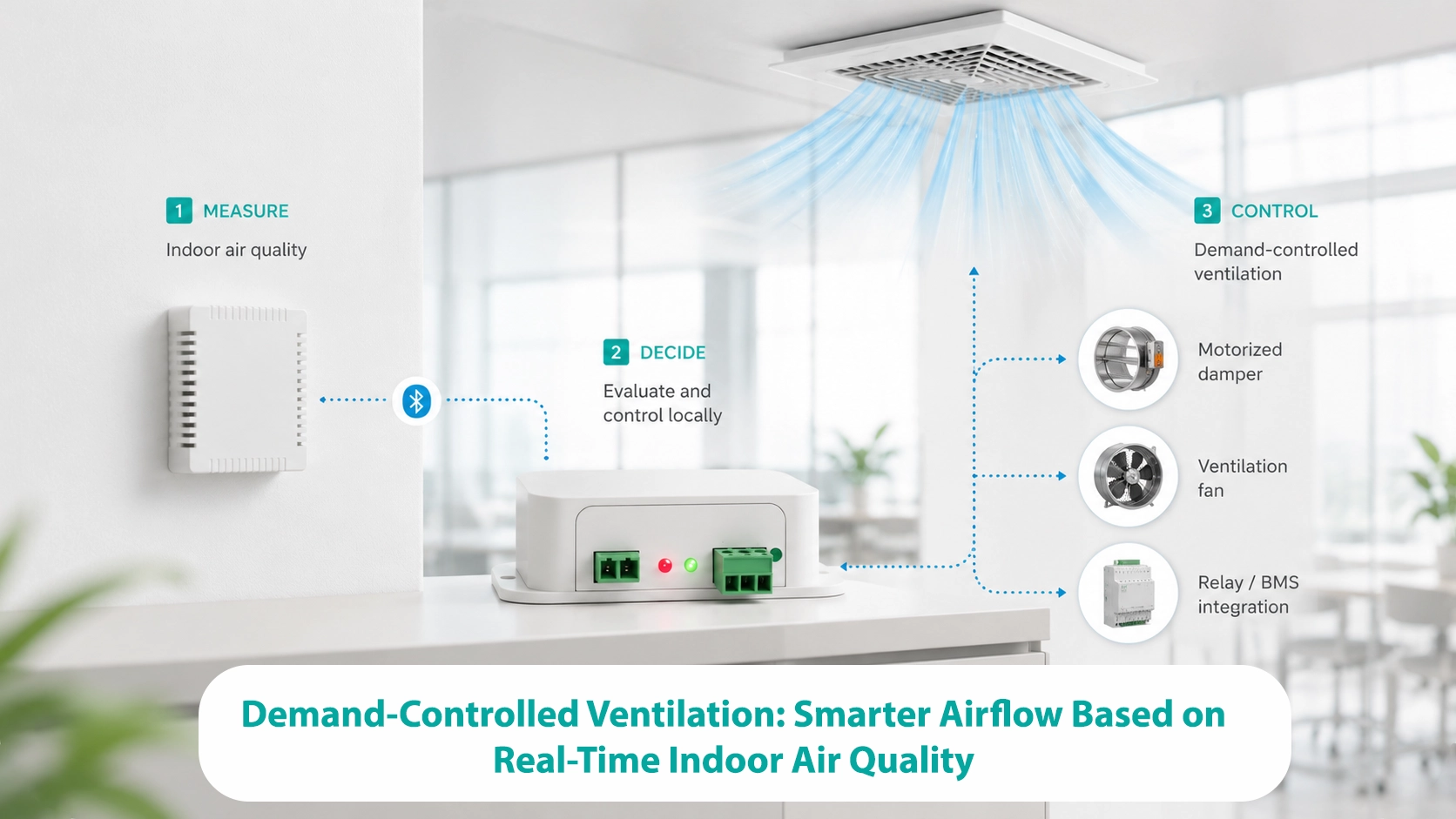


Demand-Controlled Ventilation: Smarter Airflow Based on Real-Time Indoor Air Quality
Modern buildings need ventilation that is not only reliable, but also intelligent. Traditional ventilation systems often operate on fixed schedules or static airflow settings, regardless of how many people are actually inside a space or what the indoor air quality looks like at any given moment.
This can lead to two common problems: too little ventilation when rooms are occupied, or unnecessary energy use when spaces are empty.
Demand-controlled ventilation solves this problem by adjusting ventilation based on real-time demand.
With HibouAir and ControlHub, ventilation becomes responsive, local, and easy to integrate into existing building management systems.
What Is Demand-Controlled Ventilation?
Demand-controlled ventilation, often called DCV, is a smart ventilation strategy where airflow is adjusted according to actual indoor conditions.
Instead of supplying the same amount of fresh air all day, the system responds to live data such as: CO2 levels, Temperature, Humidity, Occupancy demand, Indoor air quality changes.
When a room is empty or lightly occupied, the system can reduce fresh air intake and increase recirculation where appropriate. When occupancy increases or CO2 levels rise, the system can increase fresh air supply to maintain a healthier indoor environment.
The result is a smarter balance between indoor air quality, comfort, and energy efficiency.
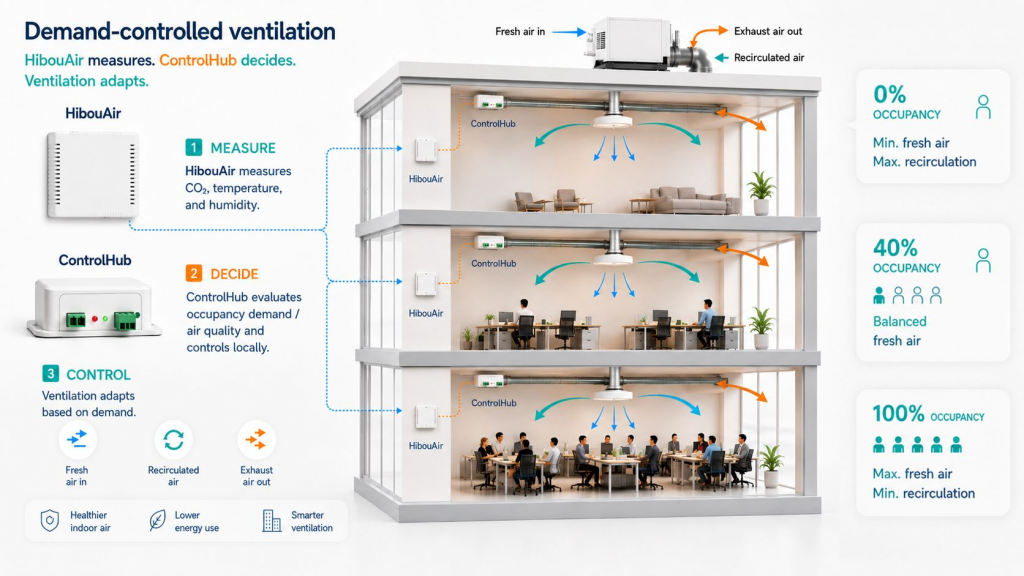
HibouAir Measures. ControlHub Decides. Ventilation Adapts.
The HibouAir demand-controlled ventilation solution is built around a simple but powerful process.
HibouAir reads indoor air quality data in real time.
The HibouAir sensor continuously monitors the indoor environment, including CO2, temperature, and humidity. These measurements provide a live picture of air quality and ventilation demand inside the building.
ControlHub gets access to the data instantly.
ControlHub receives real-time data from HibouAir and evaluates the current ventilation requirement locally. It understands when air quality is changing and when the space needs more or less fresh air.
The ventilation system adapts automatically.
Based on the measured demand, ControlHub can support ventilation adjustments such as increasing fresh air intake, balancing recirculated air, or reducing unnecessary airflow when spaces are unoccupied.
This creates a responsive ventilation system that adapts to the real conditions inside each space.
How ControlHub Supports Smarter Ventilation Decisions
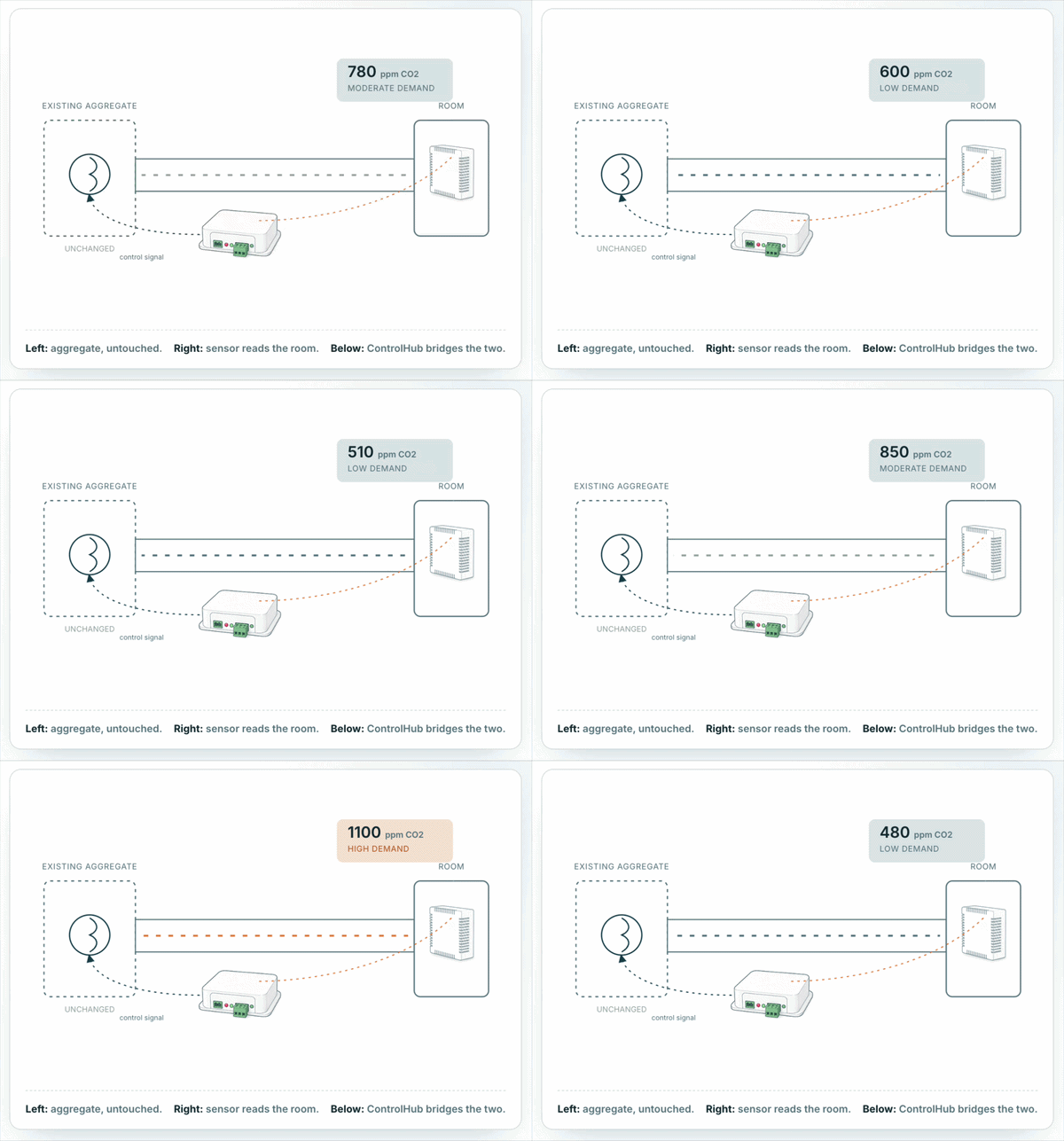
ControlHub is the decision-making layer between HibouAir sensors and the building’s ventilation system.
While HibouAir provides reliable indoor air quality measurements, ControlHub makes that data actionable. It can evaluate demand locally and provide control signals that help the ventilation system respond quickly and efficiently.
For example:
When occupancy is low, ControlHub can support minimum fresh air operation and maximize energy-saving recirculation.
When occupancy increases, ControlHub can help balance fresh air supply based on changing demand.
When occupancy is high or CO₂ levels rise, ControlHub can support maximum fresh air delivery and reduced recirculation.
This makes ventilation more dynamic and more aligned with real indoor conditions.
Easy Integration with Building Management Systems
One of the major advantages of ControlHub is that it is designed for easy integration with existing BMS environments.
Many buildings already have a Building Management System controlling HVAC equipment, dampers, fans, or air handling units. ControlHub makes it easier to bring real-time air quality intelligence into that system.
Instead of replacing the entire ventilation infrastructure, ControlHub can be integrated into the existing control architecture and provide the data or control logic needed for demand-based ventilation.
This makes it suitable for: Offices, Schools, Meeting rooms, Commercial buildings, Healthcare environments, Public buildings, Smart building retrofits.
ControlHub helps transform conventional ventilation into a smarter, sensor-driven system without unnecessary complexity.
From Static Ventilation to Adaptive Ventilation
The future of ventilation is not static. It is adaptive.
A smart building should know when a space is occupied, when CO2 levels are rising, and when additional fresh air is needed. It should also know when demand is low, so it can avoid wasting energy.
HibouAir and ControlHub make this possible.
HibouAir continuously measures indoor air quality. ControlHub receives the data in real time, evaluates ventilation demand, and enables the building ventilation system to adapt.
Together, they create a practical and intelligent demand-controlled ventilation solution for modern buildings.
Smarter Ventilation Starts with Real-Time Data
Demand-controlled ventilation is not just about moving air. It is about moving the right amount of air at the right time.
With HibouAir and ControlHub, buildings can respond to real indoor conditions instead of relying only on fixed schedules or assumptions.