


How HibouAir ControlHub Automates Ventilation Using Real-Time Air Quality Data
Good indoor air quality is not only about measuring what is happening inside a building. The real value comes when that information leads to action. In many offices, schools, healthcare facilities, and public buildings, ventilation is still managed through fixed schedules, manual settings, or occasional adjustments when people notice discomfort. By the time someone feels the room is stuffy, CO2 levels may already be high, temperature may be uncomfortable, or pollutants may have built up.
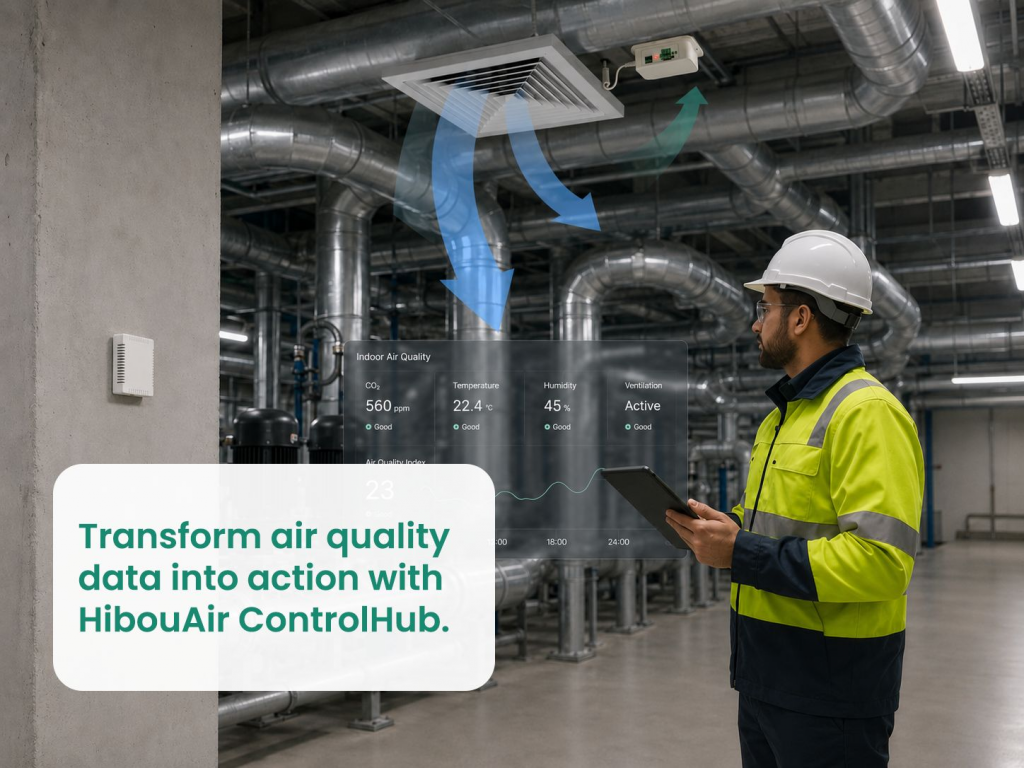
This is where ventilation automation becomes important. Instead of relying on people to open windows, adjust fans, or manually change HVAC settings, buildings can use real-time indoor air quality data to respond automatically. When air quality changes, the ventilation system can react based on actual indoor conditions.
The problem with manual ventilation
Manual ventilation is often inconsistent. A room may be well ventilated in the morning but poorly ventilated later in the day when more people enter. Meeting rooms, classrooms, clinics, and shared workspaces can change quickly depending on occupancy, activities, and outdoor conditions.
Fixed ventilation schedules also have limitations. A system may run at the same level whether a room is empty or full. This can create two common problems: under-ventilation when people are present, or unnecessary energy use when rooms do not need extra airflow.
For facility teams, this creates a difficult balance. They need to maintain comfort and indoor air quality while also controlling energy costs. Without real-time data and automatic response, they often have to make decisions based on assumptions rather than actual conditions.
Why automation makes ventilation smarter
Automated ventilation helps buildings respond to what is really happening indoors. Instead of running ventilation at one fixed level, the system can adjust based on live measurements such as CO2, temperature, humidity, particulate matter, or VOC levels.
Automation is especially useful in spaces where conditions change throughout the day. Offices, meeting rooms, classrooms, healthcare areas, public buildings, and shared facilities all benefit from ventilation that responds to real occupancy and air quality patterns.
From monitoring to real control
Air quality monitors are valuable because they show what is happening in the indoor environment. They can help identify high CO2, particle levels, humidity issues, or comfort problems. But monitoring alone does not solve the issue unless someone takes action.
The next step is connecting monitoring with control.
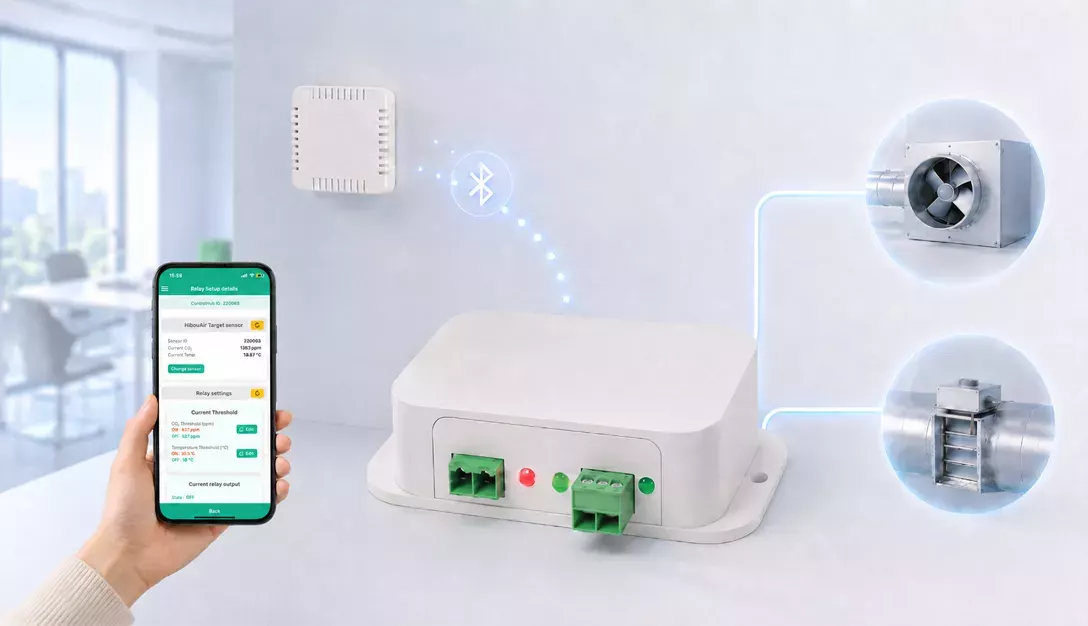
This is where solutions like HibouAir ControlHub become useful. HibouAir sensors measure indoor conditions, while ControlHub evaluates those live readings against configured thresholds and control rules. When the readings reach certain levels, ControlHub can trigger outputs to ventilation systems, dampers, fans, actuators, HVAC inputs, or building control systems.
In simple terms, the system follows a practical flow:
Monitor: HibouAir sensors measure indoor conditions such as CO2, PM, temperature, humidity, VOCs, or noise depending on the selected monitor.
Decide: ControlHub evaluates the live data against programmed minimum and maximum thresholds.
Act: ControlHub sends control outputs through 0–10VDC, relay, or Modbus connections to ventilation and HVAC equipment.
This turns indoor air quality data into a real building response.
Practical deployment for buildings
A major advantage of this type of solution is that it can be deployed in a practical way. A monitor-only setup helps identify indoor air quality issues, but adding ControlHub allows the building to respond automatically.
ControlHub is placed near the control equipment and connected to the required output. Through the supported mobile app workflow, teams can select the target HibouAir sensor, set CO2 and temperature thresholds, configure response behavior, and review the control settings.
The app is used for local configuration through Bluetooth. It does not measure air quality by itself. The live measurements come from the HibouAir sensors, while ControlHub handles the control logic and output response.
Connecting air quality data to building systems
ControlHub supports several output options for building integration. These include:
0–10VDC output for proportional control of compatible ventilation components, fans, dampers, actuators, or HVAC inputs.
Isolated relay output for switching actions when configured indoor air quality thresholds are reached.
Modbus / RS485 integration for building automation environments using Modbus RTU or ASCII over RS485 / RS422.
These options help facility teams and installers connect indoor conditions with real equipment actions. Instead of simply viewing sensor data on a dashboard, the building can respond through connected systems.
Balancing air quality and energy use
One of the strongest reasons to automate ventilation is the ability to balance indoor air quality with energy efficiency. Constant ventilation may improve airflow, but it can also waste energy when spaces are empty or conditions are already acceptable. On the other hand, reducing ventilation too much can lead to poor indoor air quality.
Real-time control helps solve this problem by allowing ventilation to respond to actual indoor conditions. The system can provide more ventilation when air quality requires it and avoid unnecessary operation when it does not.
This makes automated ventilation valuable not only for comfort and health, but also for smarter building operation.
Solutions like HibouAir ControlHub help move from passive monitoring to active control. By combining HibouAir sensors with local control logic and HVAC output options, buildings can automatically respond to changing indoor conditions.