
How Reliable Air Quality Data Helps University Researchers Understand Indoor Environments
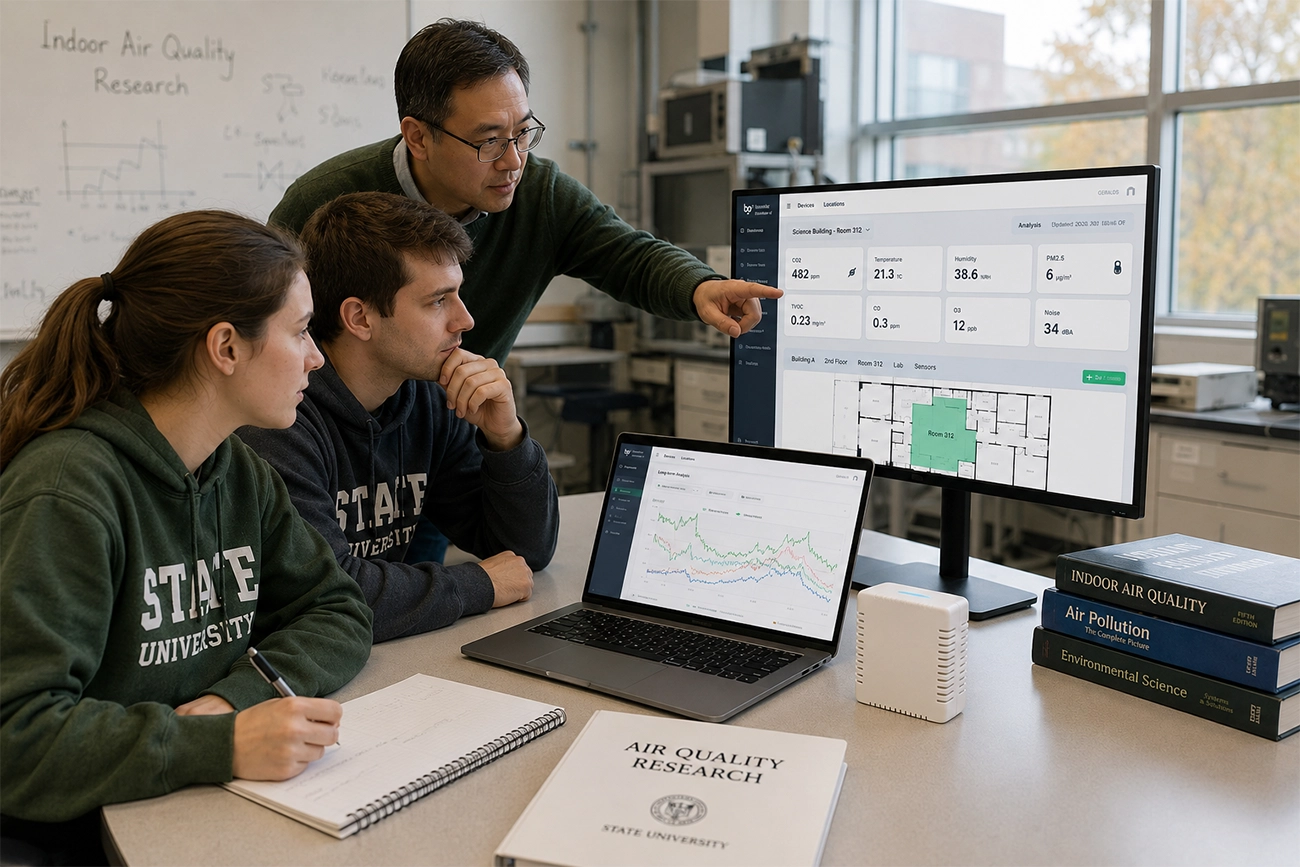
Indoor air quality has become an important research topic across many universities. Professors, students and research teams are increasingly studying how ventilation, occupancy, temperature, humidity, particulate matter, CO2 and other environmental factors affect the spaces where people study, work and spend time.
But one of the biggest challenges in indoor air quality research is not simply measuring the air. It is collecting data that is reliable enough to study over time and detailed enough to explain why conditions change.
A single CO2 reading can tell a researcher what the concentration is at that particular moment. What it cannot explain is what happened earlier, whether the same pattern happened yesterday, or whether changes in temperature, humidity or particulate matter occurred at the same time.
For researchers, that context is often where the real value is.
The Challenge of Collecting Useful Indoor Air Quality Data
Many basic air quality monitors are designed for general awareness. They may show the current CO2 concentration, temperature or humidity and give an indication of whether the air is good or poor.
That can be useful in homes or offices, but university research usually requires more than a live value on a screen.
A researcher studying a classroom may want to understand what happens when students enter the room in the morning. Does the CO2 level begin to rise immediately? How quickly does it increase? Does the ventilation system respond? How long does it take for the level to return to normal after the room becomes empty?
These questions cannot be answered by looking at the current reading alone. Researchers need to see the full sequence of events.
The same problem applies to other parameters. A change in particulate matter may be related to outdoor air entering the building, human activity or cleaning. A rise in temperature may occur alongside an increase in occupancy. Humidity may change at the same time as ventilation behaviour.
Without historical data, much of this information disappears as soon as the current value changes.
Why Reliable Measurements Matter in Research
When air quality data is being used as part of a research project, reliability becomes especially important.
A monitor that produces inconsistent readings or loses data can create gaps that make analysis difficult. This becomes even more important when researchers are trying to identify relatively small changes or compare one location with another.
Reliable historical measurements allow researchers to go back and investigate. Without that history, the spike may simply disappear from view once the room returns to normal.
Why One Parameter Is Often Not Enough
Indoor environments are complex, and this is why multi-parameter monitoring is particularly useful for research.
CO2 is commonly studied when researchers want to understand occupancy and ventilation, but it rarely tells the whole story on its own.
For example, a rise in CO₂ may occur at the same time as a slight increase in temperature because more people have entered the room. Humidity may also change. Particulate matter may remain stable, which can help rule out other sources of poor air quality.
Being able to examine several environmental parameters from the same monitoring system gives researchers a much clearer picture of what is happening.
Depending on the research project, parameters such as CO2, particulate matter, VOC, temperature, humidity, pressure, light and noise may all provide useful context.
The important point is not simply having more numbers. It is being able to compare those numbers and understand the relationship between them.
Historical Trends Can Reveal What a Live Display Cannot
One of the most useful parts of air quality monitoring for research is the ability to look back in time.
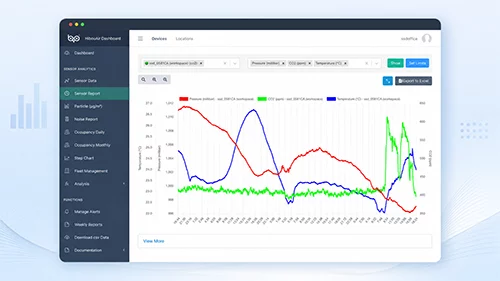
Historical trends allow researchers to see recurring patterns, identify peaks and compare different periods. They can examine what happens during occupied and unoccupied hours, compare weekdays with weekends, or study the effect of a change in ventilation settings.
This is particularly valuable in long-term research projects where the important findings may not be obvious during the first few days of monitoring.
Sometimes the most interesting result is an unexpected pattern that only becomes visible after several weeks of data have been collected.
HibouAir for University Research
This is where HibouAir can be useful for professors, students and research teams working with indoor air quality.
HibouAir has been used in university and research environments where continuous indoor environmental monitoring is required. The system is designed to provide more than a simple live air quality reading.
Depending on the HibouAir device and configuration, researchers can work with several environmental parameters, including CO2, particulate matter, VOC, temperature, humidity, pressure, light and noise.
For research projects, the value of this approach is that several aspects of the indoor environment can be observed together.
Instead of using one monitor for CO2, another for temperature and another for particulate matter, researchers can work with a more complete set of environmental data from the same monitoring approach.
This can make it much easier to understand how different conditions change together.
Looking at Air Quality Over Time with the HibouAir Dashboard
Another important part of HibouAir for research is access to historical data.
Through the HibouAir dashboard, researchers can review how measurements have changed over time rather than being limited to the latest sensor value.
For example, a researcher studying ventilation can examine CO2 data across a full day and immediately see periods where concentrations increased.
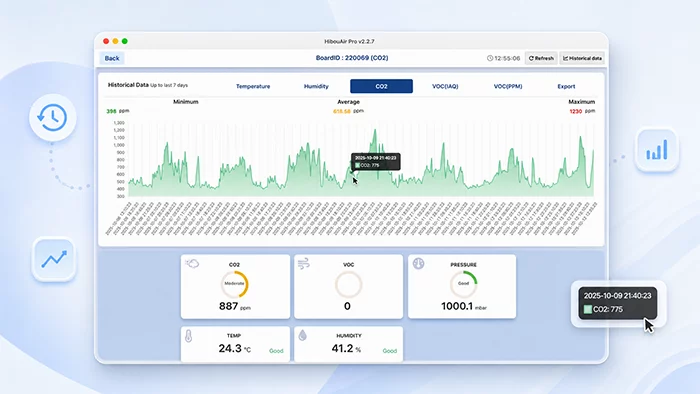
They can then zoom into those periods and investigate what happened before and after the change.
If a spike occurs around 9:30 AM, the researcher can look at the data leading up to it, see how rapidly the value increased, observe how long it remained elevated and measure how quickly it returned to normal.
The same historical approach can be applied to other environmental parameters.
For research teams, this makes the dashboard more than a monitoring screen. It becomes a useful analytical tool for identifying trends and deciding which periods deserve further investigation.
Reducing the Need for Constant Manual Measurement
Another practical challenge in university research is time.
Researchers cannot always remain in a room taking measurements throughout the day. A student working on a thesis may be monitoring several rooms while also analysing data and completing other parts of the project. A professor may be supervising multiple studies at the same time.
Continuous monitoring helps solve this problem. Once the sensors are installed, environmental measurements can continue while normal activities take place. Researchers can return later and study the periods that are relevant to their work.
This is particularly useful when something unexpected appears in the data. A researcher may initially be interested in average CO₂ concentrations but later notice an unusual spike that repeats every afternoon.
Because historical measurements are available, the researcher can investigate the pattern without having to repeat the entire monitoring period.
From Air Quality Readings to Better Research Questions
The real value of indoor air quality monitoring is not the number displayed on the screen. It is what researchers can learn from that number when it is placed in the right context.
Instead of simply asking what the CO2 concentration is right now, a researcher can ask why it increased at a particular time, whether the same event happens every day, what other environmental parameters changed at the same moment, and how quickly the ventilation system restored the room to normal conditions.
That is where reliable multi-parameter monitoring and historical data become particularly valuable.
For professors, students and research teams who are beginning an indoor air quality study, HibouAir provides a practical way to collect continuous environmental measurements, examine historical trends and investigate relationships between different indoor conditions.
It gives researchers the data they need, while leaving the most important part—the questions, analysis and conclusions—in the hands of the research team.