
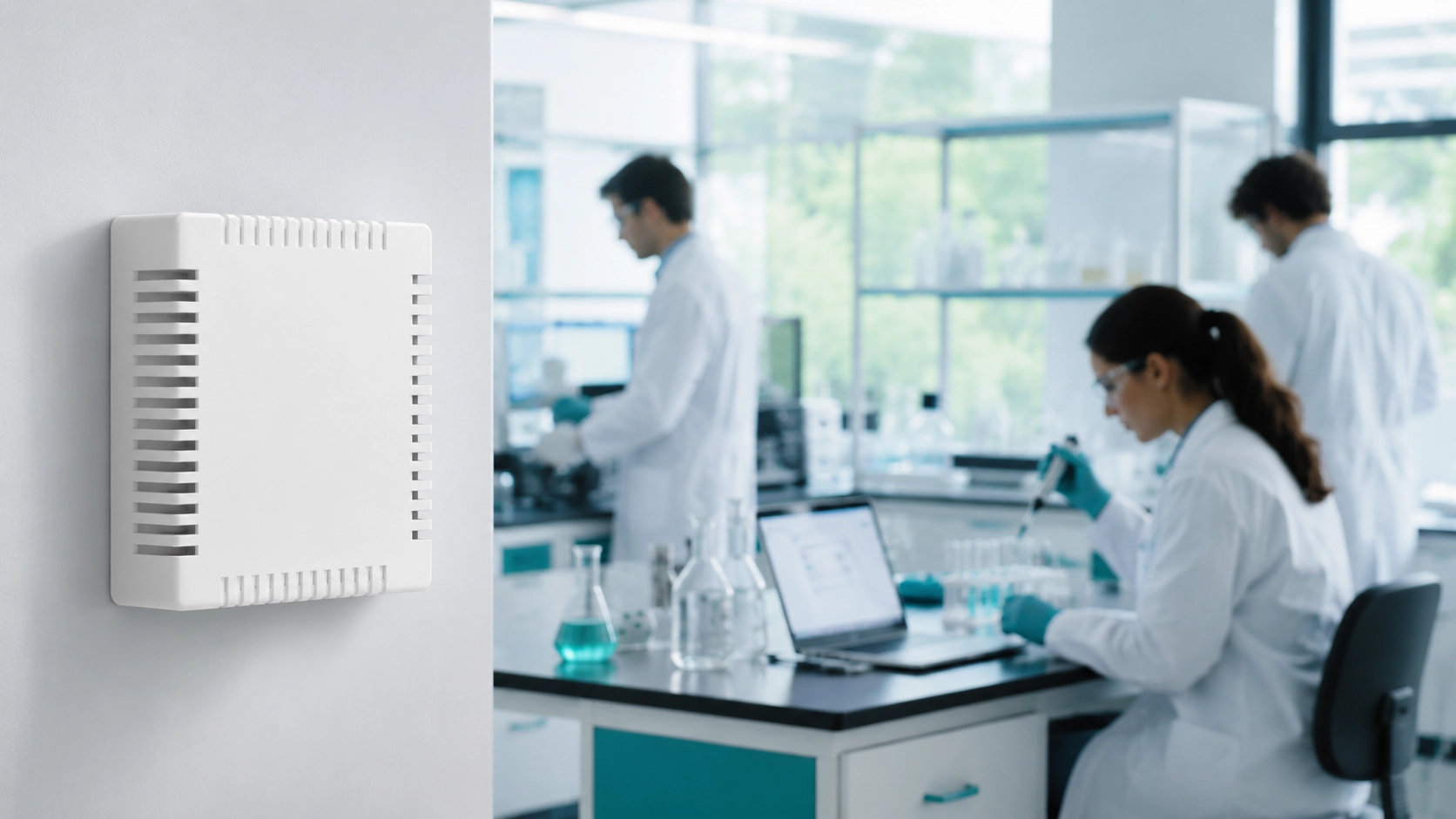


Air Quality Monitoring in Laboratories: Better Understanding the Research Environment
Laboratories are designed to be controlled environments, but the air inside them can still change throughout the day.
Researchers enter and leave, equipment runs for long periods, ventilation systems adjust, doors open and close, and different activities may influence temperature, humidity, carbon dioxide, particulate matter, and other environmental conditions.
For scientists, students, laboratory managers, and facility teams, monitoring these changes can provide useful information about the environment in which research and daily work are taking place.
Why Monitor Air Quality in a Laboratory?
A laboratory is rarely completely static. CO2 levels may increase when more people are working in the room. Temperature may rise when equipment is operating. Humidity can change depending on ventilation or seasonal conditions, while particulate matter can be influenced by activities inside the room or by outdoor air entering the building.
Without continuous monitoring, many of these changes may go unnoticed. A single measurement only shows what is happening at one moment. Continuous monitoring creates a much clearer picture by showing how conditions change over hours, days, or longer periods.
This can help answer practical questions such as whether CO2 regularly increases during busy periods, whether temperature changes when specific equipment is running, or whether particulate levels rise during particular activities.
CO2, Particulate Matter and Environmental Conditions
CO2 monitoring is particularly useful when looking at occupancy and ventilation. People continuously produce CO2 through breathing, so concentrations can increase when several people work in the same room and fresh-air ventilation is not sufficient for the level of occupancy.
Particulate matter measurements such as PM1.0, PM2.5, and PM10 provide another view of the indoor environment. These levels may be affected by outdoor pollution, ventilation, movement of people, cleaning activities, equipment, or processes taking place nearby.
Temperature and humidity are also important. They affect comfort and can provide useful context when environmental conditions are being reviewed alongside other measurements.
Looking at several parameters together often provides a more complete understanding than looking at a single value.
Historical Data Is Valuable for Research
Live readings are useful, but historical data can be even more important. A researcher may notice an unusual environmental change during an experiment, but the more interesting question is whether it has happened before. Historical measurements make it possible to identify recurring patterns, compare different periods, and understand what happened before and after a particular event.
This can be useful for university research, teaching, ventilation studies, and general environmental analysis. Students and researchers can also work with real measurements collected directly from the laboratory rather than relying only on theoretical examples.
Remote or Local Monitoring
Different laboratories have different requirements. Some teams may want remote access so researchers or facility managers can review environmental conditions without physically entering the laboratory. This is especially useful when several rooms or buildings are being monitored. Other laboratories may prefer to keep monitoring completely local because of network restrictions, privacy requirements, or the way a research project is structured.
Both approaches can be useful.
Cloud-based monitoring provides remote access to current and historical data, while Bluetooth-based monitoring allows nearby devices to communicate directly with a computer or mobile application without requiring a permanent internet connection.
Using HibouAir in Laboratory Environments
HibouAir provides several ways to monitor indoor environmental conditions depending on the needs of the laboratory.
HibouAir CO2 devices can monitor carbon dioxide together with parameters such as temperature, humidity, VOC, and atmospheric pressure. HibouAir PM devices provide particulate measurements including PM1.0, PM2.5, and PM10 together with additional environmental data.
For laboratories that want both CO2 and particulate matter measurements from one device, HibouAir DUO combines these parameters in a single monitor.
Researchers can access measurements locally through Bluetooth using the HibouAir mobile or desktop applications. For projects that require remote monitoring, HibouAir cloud solutions allow data from one or multiple locations to be accessed through the online dashboard. Historical charts and measurement data can then be used to investigate trends and compare environmental conditions over time.
Useful Data for Researchers and Facility Teams
The same monitoring data can serve different purposes.
Researchers may use it to understand whether environmental conditions changed during a study. Laboratory managers can monitor whether room conditions remain stable, while facility and HVAC teams can examine CO2, temperature, humidity, and particulate trends when evaluating ventilation or building performance.
The goal is not simply to display another set of numbers. Continuous air quality monitoring helps create a better understanding of what is happening inside the laboratory and how those conditions change over time.
For research environments where reliable environmental context matters, that visibility can be an important part of making better-informed decisions.