


Carbon Monoxide Monitoring with HibouAir DUO Extended CO
Indoor air monitoring often begins with CO2, particles, temperature and humidity. In buildings where fuel is burned or vehicle exhaust may enter, carbon monoxide deserves attention too. For facility managers and environmental assessment teams, understanding when and where CO occurs can help guide investigations and maintenance decisions.
HibouAir DUO Extended CO brings carbon monoxide measurements together with other indoor environmental data. It provides a way to document changing conditions and build a clearer record of what happens during everyday operation.
An Invisible Gas with Serious Health Risks
Carbon monoxide, or CO, is a colourless, odourless gas associated with fuel combustion, particularly incomplete combustion. Potential sources include heating appliances, gas cooking equipment, engines and generators. Faulty exhaust systems or poorly maintained combustion equipment can allow it to enter occupied spaces. [1, 2]
According to the US Centers for Disease Control and Prevention, common symptoms of CO poisoning include headache, dizziness, weakness, nausea, chest pain and confusion. Severe exposure can cause unconsciousness or death. Because CO has no smell, people cannot rely on their senses to recognise its presence. [1]
Why CO and CO2 Need Separate Measurements
Carbon monoxide and carbon dioxide are different gases. A CO2 reading does not establish whether carbon monoxide is present. An indoor assessment that includes combustion-related concerns therefore needs a dedicated CO measurement.
HibouAir DUO Extended CO measures the two gases through separate channels. This allows teams to review CO observations alongside CO₂ and particle readings without treating one parameter as a substitute for another.
Applications Worth Investigating
The following examples are potential environmental assessment projects based on recognised CO sources. They illustrate where a CO monitoring study may be useful; the instrument, placement and measurement method should be selected for each site’s conditions and risk assessment. [2]
Building services and heating systems
In buildings with fuel-burning boilers or heaters, a study can record room-air CO readings alongside heating schedules and maintenance records. This can help frame questions for a qualified service engineer. Room monitoring complements inspection of the appliance, flue and ventilation; it does not replace combustion testing.
Vehicle workshops and parking facilities
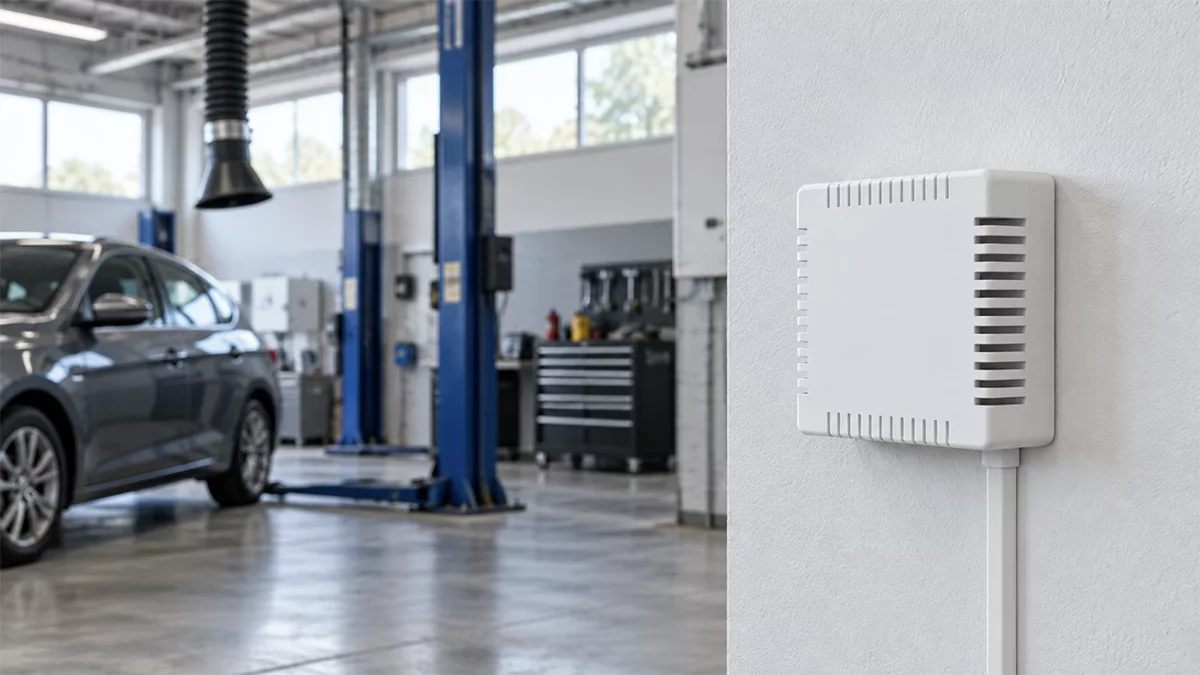
Vehicle exhaust makes CO relevant to workshops and enclosed parking areas. An assessment might compare observations at selected locations with vehicle activity and extraction-system operation. Such a study should complement the site’s required gas detection and ventilation arrangements.
Loading areas and neighbouring indoor spaces
Exhaust from vehicles near entrances or air intakes can be relevant to indoor air investigations. Recording CO in adjacent indoor spaces, together with delivery times and door-opening activity, can help a team decide where to investigate further.
Commercial kitchens with fuel-burning equipment
Gas cooking equipment is another potential source. A monitoring project can document conditions during different service periods and support a review of equipment maintenance and extraction performance. Measurements should be planned around representative locations and suitable operating conditions.
A Measurement Record with More Context
HibouAir DUO Extended CO, (SSD002/4B-4), has a stated CO range of 0–100 ppm and a resolution of 0.1 ppm. It also measures CO2, PM1.0, PM2.5, PM10, temperature and relative humidity.
The built-in data logger offers storage intervals programmable in one-minute steps. Depending on the interval, readings can be stored for days, weeks or months. Historical data and PDF reports support review and documentation.
For an investigation, the value lies in connecting these observations with operating records. Did a change coincide with a heating cycle, vehicle movement or a ventilation adjustment? Comparing timestamps can guide the next investigation, although a matching pattern alone does not prove the cause.
Monitoring as Part of a Wider Safety Strategy
CO prevention depends on controlling sources, maintaining combustion equipment and providing appropriate ventilation. Certified CO alarms and any required workplace gas detection remain essential parts of the relevant safety arrangements. [1, 2]
HibouAir’s environmental monitoring data can support assessment and documentation. The published product information does not establish the device as a certified life-safety CO alarm, and its measurement range should not be interpreted as a safe exposure range.
With a clear measurement plan, CO data can help teams turn an indoor-air concern into a focused investigation and a practical next step.
Contact HibouAir to discuss carbon monoxide monitoring, measurement locations and the configuration that suits your application.
Sources
- [1] CDC, Carbon Monoxide Poisoning Basics: https://www.cdc.gov/carbon-monoxide/about/index.html
- [2] US EPA, Carbon Monoxide’s Impact on Indoor Air Quality: https://www.epa.gov/indoor-air-quality-iaq/carbon-monoxides-impact-indoor-air-quality