


Does Your Small Building Need a full BMS for Smart Air Quality Control?
Demand-controlled ventilation is often discussed as part of large building management systems. This can make smaller building owners assume that smarter ventilation requires a major investment, extensive wiring and a complete redesign of the building’s control infrastructure.
For a large office complex, hospital or shopping centre, a full building management system may make sense. It can connect ventilation, heating, cooling, lighting, alarms and energy systems across many floors and zones.
However, many smaller buildings have a much simpler need.
A small office, clinic, classroom, shop, restaurant or community building may already have a working ventilation system. The main problem is that the system does not know when a room is busy, when indoor air quality is getting worse or when additional ventilation is actually needed.
In these buildings, the choice does not always have to be between basic fixed ventilation and a complete BMS. A smaller sensor-based control solution can often provide a more practical middle ground.
Why a full BMS may be more than the building needs
A building management system can certainly solve this fixed vs demand control ventilation problem. It can collect data from sensors, control ventilation equipment and provide central monitoring.
The difficulty is that a full BMS is rarely installed only to control one meeting room, one fan or one small ventilation unit.
It is normally part of a broader building automation project. The installation may involve new control panels, communication networks, specialist programming, engineering work and ongoing maintenance.
For a large property, that investment may be justified. For a small building with only a few rooms or one main ventilation system, it can be difficult to justify the cost and complexity.
Many smaller building owners do not need one platform controlling every technical system in the building. They simply need the ventilation to respond when indoor conditions change.
That is where a more focused form of demand-controlled ventilation becomes useful.
How HibouAir and ControlHub provide a practical solution
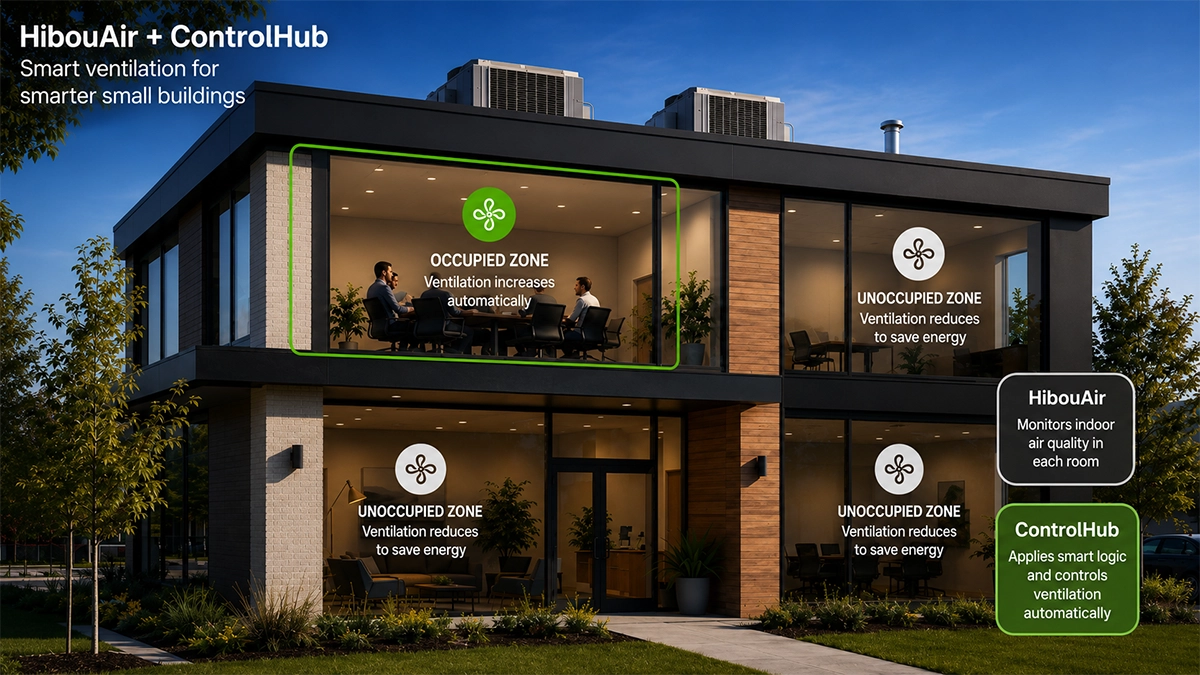
For smaller buildings, HibouAir and ControlHub can provide this demand-based control without requiring a complete building management system.
A HibouAir sensor is placed inside the occupied space to monitor indoor conditions. In a meeting room, office, classroom or waiting area, the sensor can track changes in CO2 and provide a continuous picture of how the room is performing.
The data is then used by HibouAir ControlHub.
ControlHub acts as the connection between the sensor and the ventilation equipment. When the measured value reaches the configured level, ControlHub can send a control signal to the connected fan, ventilation unit or damper.
For a simple system, this may mean switching a fan on when CO2 becomes too high and turning it off or returning it to normal operation when the level falls.
For compatible variable-speed equipment, the ventilation can be adjusted more gradually. As demand increases, airflow can increase. As conditions improve, airflow can reduce again.
The purpose is not to replace all building controls. It is to solve one specific problem: making the existing ventilation respond to actual indoor demand.
Using the ventilation system that is already installed
One of the main advantages of this type of approach is that the building may not need a completely new ventilation system.
Many existing fans and ventilation units already have some form of external control input. Depending on the equipment, this may allow the system to receive a switching signal or a variable control signal.
In these cases, HibouAir and ControlHub can add a smarter control layer to equipment that is already operating in the building.
For example, a small office may already have a supply and extract fan that runs at a fixed speed during working hours. Adding CO2 monitoring and local control can allow the fan to increase its operation only when occupancy creates additional demand.
A meeting room may have its own ventilation unit but no automatic connection between occupancy and airflow. A HibouAir sensor can identify when the room fills with people, while ControlHub can trigger the required ventilation response.
This type of retrofit can be much more realistic for small building owners than replacing the entire ventilation system or installing a full building automation platform.
The existing equipment must still be inspected by a qualified ventilation or electrical professional to confirm how it can be controlled safely.
Starting with one room or one problem area
A small building does not need to automate everything at once.
The most practical approach is often to begin with the room that has the clearest problem.
This might be a meeting room where people regularly complain about stuffiness, a classroom where CO2 rises during lessons or a waiting area with unpredictable occupancy.
The first step is to monitor the room and understand how indoor conditions change throughout the day.
A HibouAir standalone solution can be used to assess conditions locally and review the measurements before any control changes are made.
This helps answer important questions. Does CO2 rise every time the room is full? Does the existing ventilation eventually bring the level down? Does the problem occur because the system starts too late, runs too slowly or does not respond at all?
After the pattern is clear, ControlHub can be introduced to automate the required response.
Starting with one room reduces risk and makes it easier to evaluate the result. If the solution improves indoor conditions and performs as expected, the same approach can later be applied to other rooms or ventilation zones.
Local control without depending on a large platform
For a small demand-controlled ventilation project, the main requirement is reliable local operation.
The ventilation should be able to respond even when the building does not have a central automation platform.
HibouAir and ControlHub allow the sensing and control process to take place close to the equipment. The building does not need to send every control decision through a large cloud system or a central BMS.
This can make the installation easier to understand and maintain. The sensor measures the room. ControlHub applies the control logic. The ventilation equipment responds.
A full BMS is not always necessary to make a building smarter. Sometimes the most effective solution is simply to measure the real demand and give the existing ventilation system a way to respond.