
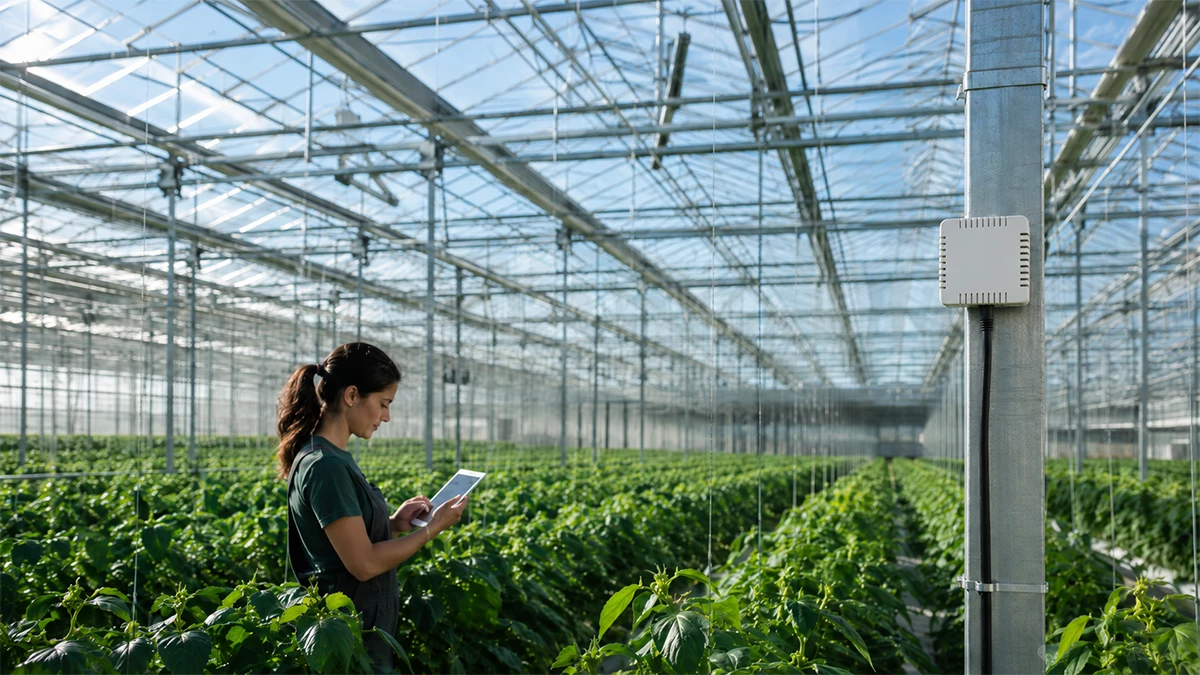


Air Quality Monitoring in Greenhouses: Creating Better Conditions for Healthier Crops
Temperature, humidity, ventilation, light, irrigation and other growing conditions can be managed far more closely than in an open field. But that control also means the greenhouse becomes its own small environment. What happens inside it can change quickly, sometimes without being obvious until plants begin to show signs of stress.
This is where air quality monitoring becomes increasingly important.
When people hear the term air quality monitoring, they often think about offices, schools or homes. In a greenhouse, however, monitoring the surrounding air can be just as useful. The conditions around the plants influence transpiration, photosynthesis, disease risk, worker comfort and the overall stability of the growing environment.
Modern environmental sensors make it possible to understand these conditions continuously rather than relying only on occasional manual checks.
Why Air Quality monitoring is important Inside a Greenhouse
A greenhouse is a dynamic environment. During the day, sunlight can quickly increase the internal temperature. Plants release moisture through transpiration, which can push humidity upward. Ventilation systems open and close, heating systems switch on, workers enter and leave, and CO2 levels change as plants consume carbon dioxide during photosynthesis.
All of these factors interact. Without measurements, it is difficult to understand exactly what is happening.
A grower may know that the greenhouse feels warm or humid, but continuous monitoring provides a much clearer picture. It shows not only the current condition, but also how the environment has behaved over the previous hours, days or weeks.
That historical information can often be more valuable than a single reading.
The Challenge Is Not Just Measuring — It Is Understanding
The temperature close to an entrance of a greenhouse may be different from the temperature in the centre of the growing area. Humidity may be higher close to dense plant canopies. Air movement near a ventilation outlet may create very different conditions from those found several metres away. A single sensor cannot always represent the entire greenhouse.
Another challenge is that environmental parameters influence one another. Looking only at temperature, for example, may not explain why plants are experiencing stress. Temperature combined with humidity, CO2 and other measurements can provide much more useful context. Historical data is also important.
From Manual Measurements to Continuous Monitoring
Traditional greenhouse management often depends on individual thermometers, humidity meters or readings taken manually at different times of the day. These measurements still have value, but they provide snapshots.
Modern environmental monitoring systems can continuously collect measurements and build a picture of how the greenhouse changes over time. Temperature and relative humidity are usually among the most useful parameters to monitor. CO2 can provide valuable information about ventilation, plant activity and CO2 supplementation strategies.
The important point is not necessarily to monitor every possible parameter. It is to choose measurements that help explain what is happening inside the greenhouse.
Remote Monitoring Makes Greenhouse Management Easier
One of the biggest changes in environmental monitoring has been the move from standalone displays to connected monitoring.
A greenhouse may be located away from the main office, or a business may operate several growing areas across different locations. Physically checking every greenhouse several times a day is not always practical. Remote monitoring changes that.
With connected sensors and a cloud dashboard, environmental conditions can be viewed without being physically present inside the greenhouse. A grower can check current readings from an office computer, review historical graphs later in the day or access information remotely while away from the site.
Mobile access can be particularly useful in this situation. Instead of needing to stand beside a sensor to see what is happening, users can access environmental information from a phone or tablet when the monitoring setup supports cloud connectivity.
This does not replace physical inspection of the plants. It simply provides another source of information that helps operators decide when an inspection or adjustment may be necessary.
Using HibouAir for Greenhouse Environmental Monitoring
HibouAir is one example of an environmental monitoring platform that can be applied to greenhouse environments.
Different HibouAir models are designed to measure combinations of environmental parameters such as temperature, relative humidity, CO2, VOC, PM1.0, PM2.5, PM10 and atmospheric pressure. This makes it possible to select a monitoring device according to the conditions that are most relevant for a particular greenhouse.
For a relatively simple greenhouse application, temperature and humidity monitoring may already provide valuable information. In another greenhouse, CO2 may be particularly important because the grower wants to understand how concentrations change during the growing cycle or evaluate a CO2 supplementation strategy.
A multiparameter HibouAir device can also help when the goal is to understand relationships between different environmental conditions rather than looking at each measurement independently.
Historical Data Can Reveal What You Do Not See
One of the most useful aspects of continuous environmental monitoring is the ability to look backwards. The greenhouse might appear completely normal during an afternoon inspection, yet the historical graph may reveal that the temperature increased sharply earlier in the day. Looking at these patterns over several days can help identify recurring behaviour.
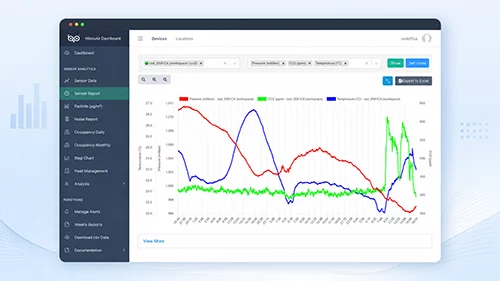
Perhaps humidity rises every night at approximately the same time. Perhaps CO2 drops quickly after sunrise. Perhaps one section of the greenhouse consistently becomes warmer than the others during the afternoon. These patterns are difficult to identify from occasional manual measurements.
HibouAir’s cloud-based monitoring options allow users to review historical environmental data remotely, making it possible to analyse these trends without continuously being present in the greenhouse.
For smaller or more local installations, HibouAir also offers monitoring approaches that can work through mobile or desktop applications, depending on the chosen device and deployment method.
A More Informed Greenhouse
Greenhouse farming is becoming increasingly data-driven, but useful monitoring does not need to be complicated. Even a small number of well-placed environmental sensors can provide valuable insight into how conditions change throughout the day and night.
Continuous monitoring, historical trends and remote access give growers a better understanding of an environment that would otherwise be difficult to observe continuously.
Solutions such as HibouAir make it possible to monitor several relevant environmental parameters while giving users different ways to access their data, from local mobile and desktop monitoring to cloud-based dashboards for remote and multi-location installations.