
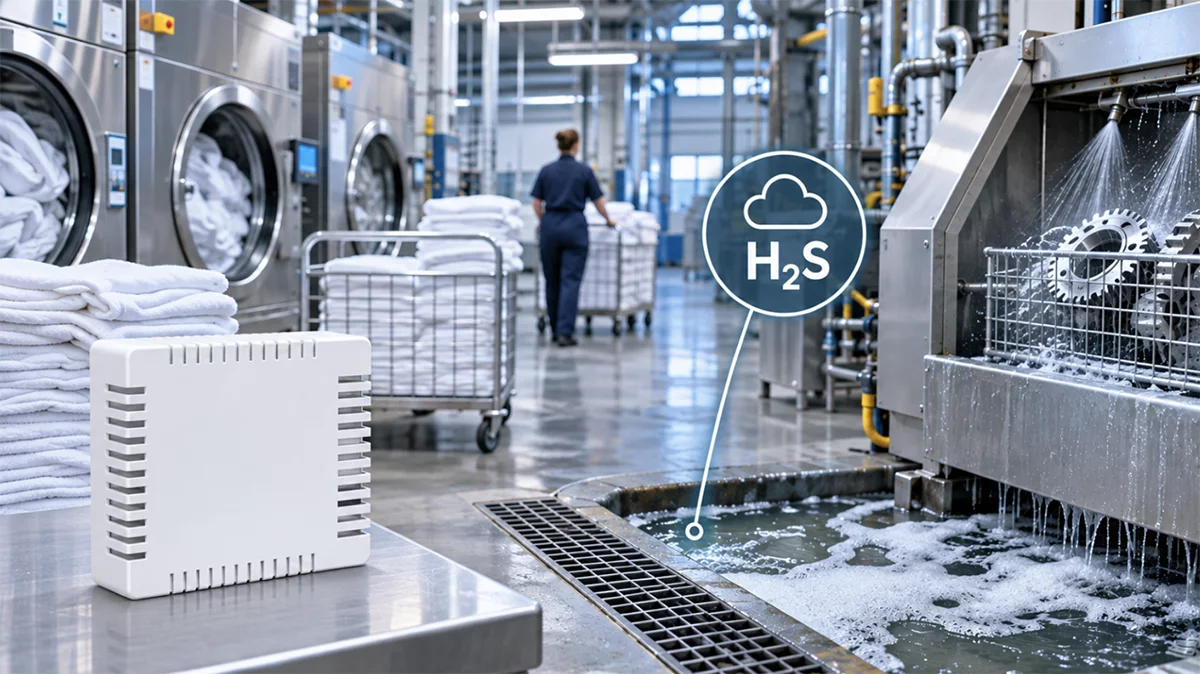


Hydrogen Sulfide Monitoring in Industrial Laundry and Washing Facilities – Understanding Hidden Air Quality Risks
Industrial washing facilities operate in demanding environments where water, chemicals, heat, and wastewater management are essential parts of daily operations. Whether a facility processes thousands of kilograms of textiles or cleans metal components for manufacturing industries, maintaining a safe and well-controlled working environment is an important responsibility.
While most attention is given to washing efficiency, chemical handling, and equipment maintenance, one potential environmental concern may receive less attention: hydrogen sulfide (H₂S).
In facilities where wastewater contains organic material and is exposed to oxygen-deficient conditions, hydrogen sulfide can develop and create challenges for workplace safety, equipment maintenance, and environmental management.
Understanding when and where H₂S may occur is an important first step toward better monitoring and preventive maintenance.
Industrial Laundry Facilities – Where Can Hydrogen Sulfide Become a Concern?
Commercial and industrial laundries handle large quantities of textiles every day. These operations include washing workwear, hotel linens, hospital textiles, uniforms, and other materials used in professional environments.
The washing process generates wastewater containing varying amounts of detergents, organic residues, dirt, and other contaminants.
Under certain conditions, particularly when wastewater remains stagnant or organic matter decomposes in environments with limited oxygen, hydrogen sulfide may form.
Potential areas of concern include:
- Wastewater collection tanks and holding systems
- Drainage channels and wastewater pits
- Wastewater treatment and equalization tanks
- Pumping stations and poorly ventilated wastewater areas
- Enclosed technical spaces connected to wastewater handling
Not every industrial laundry will experience hydrogen sulfide problems. The risk depends on wastewater composition, operating conditions, ventilation, and the design of the wastewater system.
However, for facilities with recurring unpleasant odors, wastewater-related corrosion, or concerns about air quality near wastewater handling areas, H₂S monitoring may provide valuable information.
Industrial Parts Washing and Metal Cleaning Facilities
Industrial washing is not limited to textiles. Many manufacturing companies use specialized washing equipment to clean metal components, automotive parts, mechanical assemblies, and industrial machinery.
These systems may use water-based cleaning solutions, detergents, solvents, or other chemical processes to remove oils, grease, particles, and manufacturing residues.
Hydrogen sulfide is not normally expected from the washing of metal components itself. However, certain wastewater treatment processes, contaminated water systems, or associated industrial operations may create conditions where H₂S becomes relevant.
For manufacturers and suppliers of industrial washing equipment, understanding the surrounding operating environment can therefore be important.
Environmental monitoring may help equipment manufacturers and industrial operators investigate conditions in wastewater-related technical areas and evaluate changes during normal operation.
The relevance of H₂S monitoring should always be determined by the specific process and its potential sources of gas.
Why Hydrogen Sulfide Matters in Industrial Washing Environments
Hydrogen sulfide is a colorless gas commonly associated with the smell of rotten eggs. It can form when microorganisms break down organic material in oxygen-deficient environments.
In industrial facilities, the consequences of hydrogen sulfide can extend beyond unpleasant odors.
1. Workplace Health and Safety
Hydrogen sulfide is toxic, and exposure to elevated concentrations can cause serious health effects.
One challenge is that smell cannot be relied upon as a warning system. At dangerous concentrations, hydrogen sulfide can impair the sense of smell, making the gas particularly hazardous.
Facilities with potential H₂S exposure must use appropriate risk assessments, safety procedures, and certified gas detection equipment where required.
2. Corrosion and Equipment Maintenance
Hydrogen sulfide can contribute to corrosive conditions, particularly in moist wastewater environments.
Over time, H₂S-related corrosion may affect certain metal components, wastewater infrastructure, and concrete surfaces.
For industrial washing facilities, this can create additional maintenance requirements involving wastewater tanks, drainage systems, and associated infrastructure.
Understanding environmental conditions may help maintenance teams identify areas that require further investigation.
3. Wastewater Management
Wastewater management is an important part of industrial laundry operations.
Changes in wastewater composition, retention time, temperature, and oxygen availability can influence the conditions under which hydrogen sulfide develops.
Monitoring H₂S in relevant surrounding areas can provide additional information when investigating wastewater-related problems.
4. Understanding Changes Over Time
A single measurement provides information about gas concentration at a particular moment.
However, industrial operations often change throughout the day.
Washing cycles, wastewater discharge, pumping operations, and maintenance activities can influence conditions in different parts of a facility.
Collecting measurement data over time can help identify recurring patterns and support more informed operational decisions.
HibouAir DUO Extended H₂S – Monitoring Hydrogen Sulfide Alongside Indoor Air Quality
For industrial facilities looking to better understand hydrogen sulfide levels and surrounding environmental conditions, HibouAir DUO Extended H₂S provides a compact monitoring solution.
The device combines dedicated hydrogen sulfide measurement with several additional indoor air quality parameters.
HibouAir DUO Extended H₂S measures:
- Hydrogen sulfide (H₂S): 0–100 ppm
- H₂S measurement resolution: 0.01 ppm
- Carbon dioxide (CO₂)
- Particulate matter: PM1.0, PM2.5, and PM10
- Temperature
- Relative humidity
By combining these measurements, facility managers and maintenance teams can investigate H₂S trends alongside changes in the surrounding indoor environment.
For example, temperature and humidity data may provide useful context when reviewing conditions in technical rooms or wastewater-related areas.
The integrated data logger also allows measurements to be stored at programmable intervals, making it possible to review historical environmental conditions.
Rather than relying only on individual readings, users can investigate how measured conditions change during different operating periods.
Practical Applications in Industrial Washing Facilities
HibouAir DUO Extended H₂S can be considered for environmental monitoring projects in several types of industrial facilities.
Commercial and Industrial Laundries
Facilities washing hotel textiles, healthcare textiles, uniforms, and industrial workwear may benefit from investigating H₂S levels in relevant wastewater handling areas.
Textile Processing Facilities
Industrial textile processing operations with wastewater collection or treatment systems may use H₂S measurement data to better understand environmental conditions around these processes.
Industrial Parts Washing Facilities
Companies operating industrial component cleaning systems may consider H₂S monitoring where wastewater characteristics or associated processes indicate a potential hydrogen sulfide concern.
Manufacturers of Industrial Washing Equipment
Equipment manufacturers and system integrators may use environmental monitoring during testing, site assessments, or customer projects where hydrogen sulfide is relevant to the application.
Industrial Wastewater Treatment Operations
Facilities managing wastewater from industrial washing processes may use H₂S trend data to support investigations, maintenance planning, and environmental assessments.
From Environmental Measurements to Better Maintenance Decisions
Industrial washing facilities increasingly rely on measurement data to improve operational visibility.
Understanding environmental conditions can help maintenance teams investigate potential problems before they develop into larger operational challenges.
For example, an industrial laundry experiencing recurring odors near a wastewater holding tank may want to investigate whether hydrogen sulfide is present and how concentrations change during the working day. By collecting H₂S measurements over time, the facility can compare different operating periods and evaluate conditions before and after maintenance or ventilation improvements.
Similarly, an industrial equipment manufacturer may want to document environmental conditions during a wastewater-related customer installation.
In both cases, historical measurements can provide useful information for technical analysis and decision-making.
HibouAir DUO Extended H₂S is designed for environmental measurement and trend monitoring. It is not a substitute for certified personal H₂S detectors, fixed safety alarm systems, or the protective procedures required for hazardous areas and confined spaces.
Monitoring locations and equipment suitability should always be determined through a site-specific risk assessment.
Better Environmental Visibility for Industrial Washing Operations
Industrial laundry and washing facilities depend on reliable equipment, effective wastewater management, and well-maintained working environments.
Although hydrogen sulfide is not a concern in every washing process, it can become relevant in facilities where wastewater and organic material create conditions favorable to its formation.
Understanding these conditions through measurement data can support better investigations, maintenance planning, and environmental management.
With HibouAir DUO Extended H₂S, industrial operators can monitor hydrogen sulfide alongside CO₂, particulate matter, temperature, and humidity in one compact device.
The result is a broader view of the monitored environment and more information to support operational decisions.
Interested in Monitoring Hydrogen Sulfide in Your Facility?
Are you operating an industrial laundry, managing wastewater from washing processes, or manufacturing industrial cleaning equipment?
Discover how HibouAir DUO Extended H₂S can support your environmental monitoring needs.
Explore the product or contact the HibouAir team to discuss your application, measurement requirements, and suitable monitoring locations.